
GCSE Combined Science (AQA)
622 videos | 38 hours
Please subscribe to watch this video.
This, and all other videos, are included in our premium subscriptions.
Premium accounts get access to all videos.
Enable autoplay to keep watching
Your browser is blocking videos from playing automatically. To turn it back on:
Safari (Mac): Click the Safari menu item in the top bar, then Settings → Websites → Auto-Play, then set Auto-Play to Allow All Auto-Play for the current website.
Safari (iPhone/iPad): open the Settings app, then Apps → Safari → Auto-Play, and select Allow All Auto-Play.
Negative Feedback Cycles
- Negative feedback maintains stable body conditions.
- Stimuli, changes in the environment, can be internal or external.
- Example: A drop in body temperature is an internal change.
- Shivering counteracts a drop in temperature, helping return the body to a set point.
- Counteracting means acting in the opposite direction to neutralize a change.
- Negative feedback operates in cycles to maintain homeostasis.
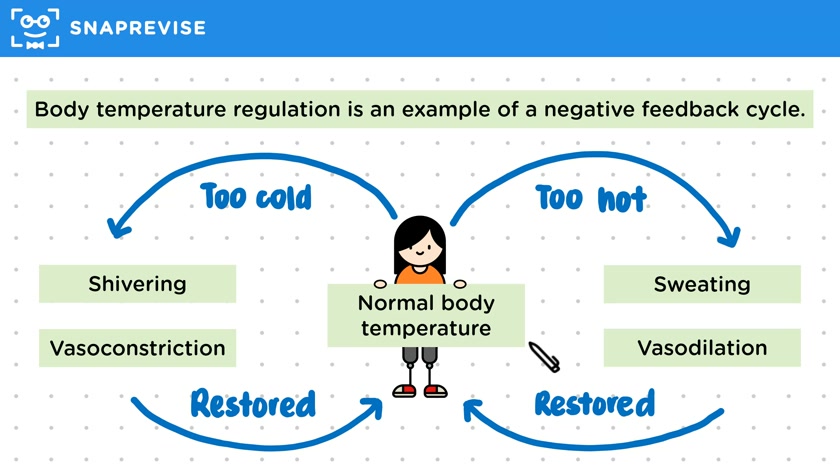
- Body temperature regulation is an example of a negative feedback cycle.
- Decreased body temperature triggers shivering and vasoconstriction to restore normal temperature.
- Increased body temperature triggers sweating and vasodilation to reduce body heat.
- Blood glucose regulation is another example of negative feedback.
- Low glucose levels trigger glucagon production; high levels trigger insulin production, both restoring optimal glucose levels.
- Negative feedback cycles aim to maintain levels within an optimum range, responding to deviations by increasing or decreasing the level as needed.
- Other body processes controlled by negative feedback include water levels by kidneys, glucose by pancreas, thyroxine by pituitary gland, and body temperature by the thermoregulatory center.
Please subscribe to access these revision notes.
This, and all other video notes, are included in our premium subscriptions.
Premium accounts get access to all videos and revision notes.
95
questions for Homeostasis and Response
72
questions for Hormonal Coordination in Humans