
GCSE Combined Science (AQA)
622 videos | 38 hours
Please subscribe to watch this video.
This, and all other videos, are included in our premium subscriptions.
Premium accounts get access to all videos.
Enable autoplay to keep watching
Your browser is blocking videos from playing automatically. To turn it back on:
Safari (Mac): Click the Safari menu item in the top bar, then Settings → Websites → Auto-Play, then set Auto-Play to Allow All Auto-Play for the current website.
Safari (iPhone/iPad): open the Settings app, then Apps → Safari → Auto-Play, and select Allow All Auto-Play.
Newton's Second Law Equation
- Newton's second law can be expressed as an equation.
- The acceleration of an object is proportional to the resultant force acting on it.
- Doubling the resultant force doubles the acceleration.
- Acceleration is inversely proportional to the mass of the object.
- Doubling the mass halves the acceleration.
- Acceleration is proportional to the resultant force divided by the mass.
- The resultant force equals mass multiplied by acceleration (F = M * A).
- F = M * A is a crucial equation related to forces.
- Mass is measured in kilograms, acceleration in meters per second squared, and force in Newtons.
- One Newton is defined as the force that gives a one-kilogram object an acceleration of one meter per second squared.
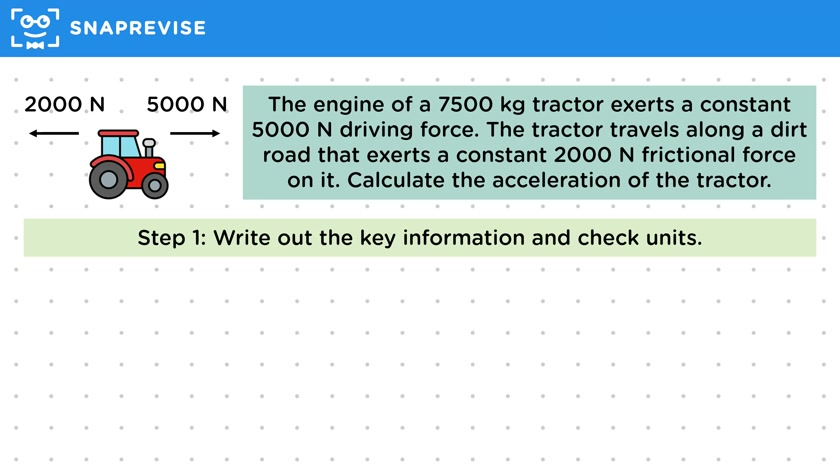
- Example problem: Calculate the acceleration of a 7,500 kg tractor with a 5,000 Newton driving force and a 2,000 Newton frictional force.
- Step 1: Write out key information and check units.
- Step 2: Calculate the resultant force (5,000 N - 2,000 N = 3,000 N).
- Step 3: Rearrange the equation to make acceleration the subject (acceleration = resultant force / mass).
- Step 4: Substitute values to find acceleration (3,000 N / 7,500 kg = 0.4 m/s��).
Please subscribe to access these revision notes.
This, and all other video notes, are included in our premium subscriptions.
Premium accounts get access to all videos and revision notes.
114
questions for Forces
95
questions for Forces and motion