
GCSE Combined Science (AQA)
622 videos | 38 hours
Please subscribe to watch this video.
This, and all other videos, are included in our premium subscriptions.
Premium accounts get access to all videos.
Enable autoplay to keep watching
Your browser is blocking videos from playing automatically. To turn it back on:
Safari (Mac): Click the Safari menu item in the top bar, then Settings → Websites → Auto-Play, then set Auto-Play to Allow All Auto-Play for the current website.
Safari (iPhone/iPad): open the Settings app, then Apps → Safari → Auto-Play, and select Allow All Auto-Play.
Parachuting
- Skydivers use parachutes to lower their terminal velocity.
- Terminal velocity is the constant speed reached when falling.
- Parachuting is a common example of terminal velocity in exams.
- Step 1: Skydiver accelerates downwards due to weight and air resistance.
- Weight is stronger than air resistance initially, causing downward acceleration.
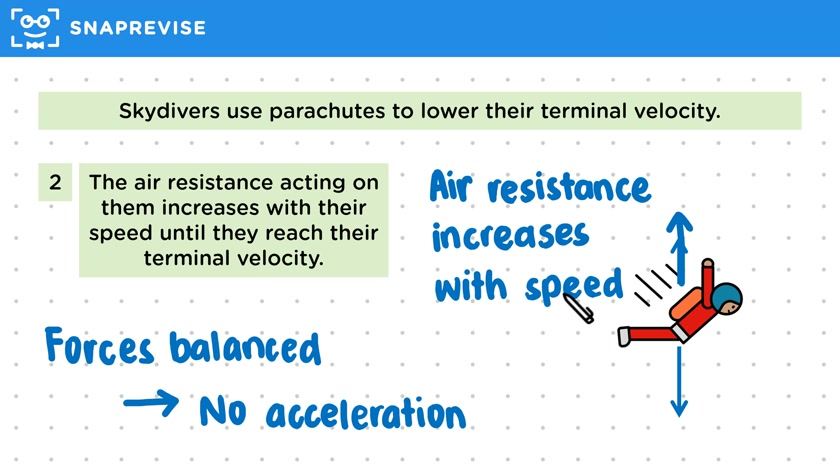
- Step 2: Air resistance increases with speed until it equals the skydiver's weight.
- Forces balance, resulting in no acceleration and constant speed (terminal velocity).
- Terminal velocity is too dangerous to land at, requiring deceleration.
- Step 3: Skydiver deploys parachute, increasing air resistance.
- Parachute's large surface area increases collisions with air molecules.
- Air resistance becomes stronger than weight, causing deceleration.
- Timing of parachute deployment is crucial for effectiveness.
- Step 4: Skydiver decelerates to a new, slower terminal velocity.
- Air resistance decreases as the skydiver slows down.
- New terminal velocity is safe for landing due to balanced forces.
- Parachute allows for a slower, safer landing speed.
Please subscribe to access these revision notes.
This, and all other video notes, are included in our premium subscriptions.
Premium accounts get access to all videos and revision notes.
114
questions for Forces
95
questions for Forces and motion