
GCSE Combined Science (AQA)
622 videos | 38 hours
Please subscribe to watch this video.
This, and all other videos, are included in our premium subscriptions.
Premium accounts get access to all videos.
Enable autoplay to keep watching
Your browser is blocking videos from playing automatically. To turn it back on:
Safari (Mac): Click the Safari menu item in the top bar, then Settings → Websites → Auto-Play, then set Auto-Play to Allow All Auto-Play for the current website.
Safari (iPhone/iPad): open the Settings app, then Apps → Safari → Auto-Play, and select Allow All Auto-Play.
Percentage by Mass Calculations
- Calculate the percentage of total mass of a compound made up of a single element.
- These are called percentage by mass calculations.
- Example: Sodium chloride (table salt) has sodium forming 39% of the mass and chlorine 61%.
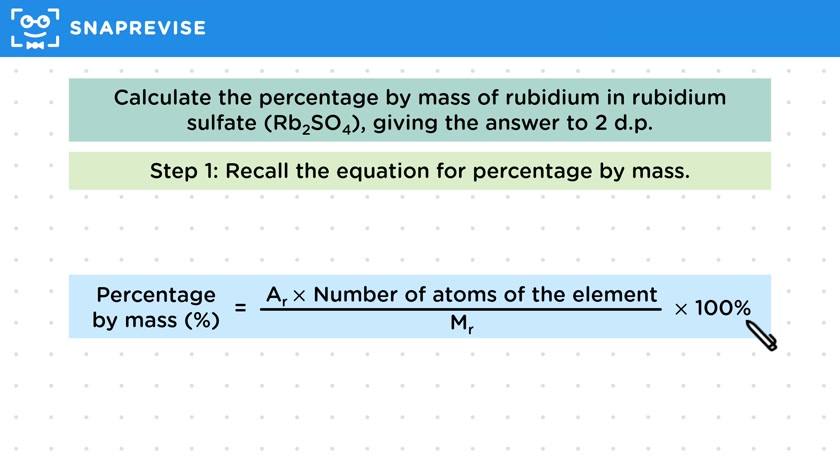
- Formula: Percentage by mass = (AR of element * number of atoms) / MR of compound * 100.
- Example calculation with lithium fluoride:
- AR of lithium is 7.
- MR of lithium fluoride is 26 (7 for lithium + 19 for fluorine).
- Percentage by mass of lithium = (7 * 1) / 26 * 100 = 26.92%.
- More complex example: Rubidium in rubidium sulfate (RB���SO���).
- AR of rubidium is 85, with 2 atoms in the compound.
- MR of rubidium sulfate is 266.
- Percentage by mass of rubidium = (85 * 2) / 266 * 100 = 63.91% (rounded to two decimal places).
Please subscribe to access these revision notes.
This, and all other video notes, are included in our premium subscriptions.
Premium accounts get access to all videos and revision notes.
17
questions for Quantitative chemistry
4
questions for Chemical measurements, conservation of mass and the quantitative interpretation of chemical equations