
GCSE Combined Science (AQA)
622 videos | 38 hours
Please subscribe to watch this video.
This, and all other videos, are included in our premium subscriptions.
Premium accounts get access to all videos.
Enable autoplay to keep watching
Your browser is blocking videos from playing automatically. To turn it back on:
Safari (Mac): Click the Safari menu item in the top bar, then Settings → Websites → Auto-Play, then set Auto-Play to Allow All Auto-Play for the current website.
Safari (iPhone/iPad): open the Settings app, then Apps → Safari → Auto-Play, and select Allow All Auto-Play.
Periodic Table Structure
- Elements are arranged in rows in the periodic table.
- Listed in order of increasing atomic or proton number.
- Atomic numbers are written under the element symbols.
- Numbers increase from top left to bottom right.
- Rows are called periods; there are seven periods in total.
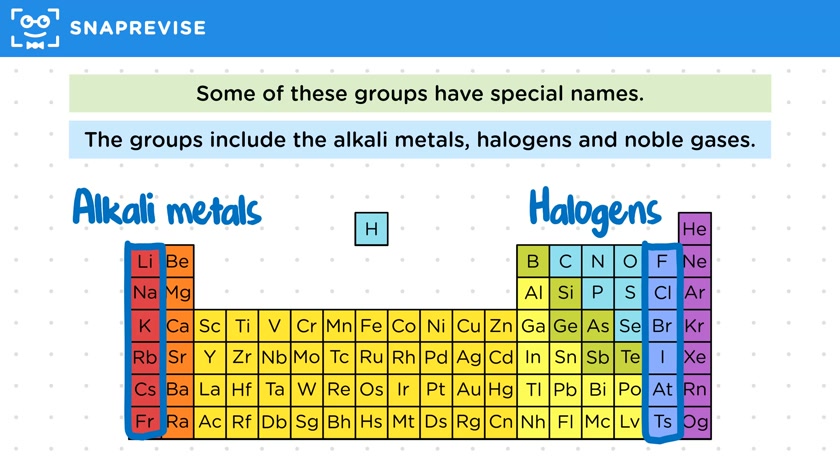
- Columns are known as groups; there are eight groups in total, with the last group known as Group zero.
- Some groups have special names: alkaline metals, halogens, and noble gases.
- Group one (alkaline metals) is highly reactive.
- Group zero (noble gases) is highly unreactive.
- Elements in each group have similar properties.
- The periodic table is called "periodic" because similar properties occur at regular intervals.
- Each row starts with a very reactive metal, then less reactive metals, non-metals, and ends with an unreactive noble gas.
- The pattern repeats with each new row.
- Hydrogen is an exception to the pattern and is often drawn separately.
Please subscribe to access these revision notes.
This, and all other video notes, are included in our premium subscriptions.
Premium accounts get access to all videos and revision notes.
57
questions for Atomic structure and the periodic table
5
questions for The periodic table