
GCSE Combined Science (AQA)
622 videos | 38 hours
Please subscribe to watch this video.
This, and all other videos, are included in our premium subscriptions.
Premium accounts get access to all videos.
Enable autoplay to keep watching
Your browser is blocking videos from playing automatically. To turn it back on:
Safari (Mac): Click the Safari menu item in the top bar, then Settings → Websites → Auto-Play, then set Auto-Play to Allow All Auto-Play for the current website.
Safari (iPhone/iPad): open the Settings app, then Apps → Safari → Auto-Play, and select Allow All Auto-Play.
Properties of Small Molecules
- Small molecules have a simple covalent structure.
- Examples include hydrogen (H2), ammonia (NH3), and carbon dioxide (CO2).
- Ball and stick models represent these molecules, showing covalent bonds.
- Small molecules have a fixed number of atoms; e.g., CO2 is always CO2.
- Many substances, like water (H2O), are made up of small molecules.
- Water consists of two hydrogen atoms bonded to an oxygen atom.
- A glass of water contains approximately 6.7 septillion molecules.
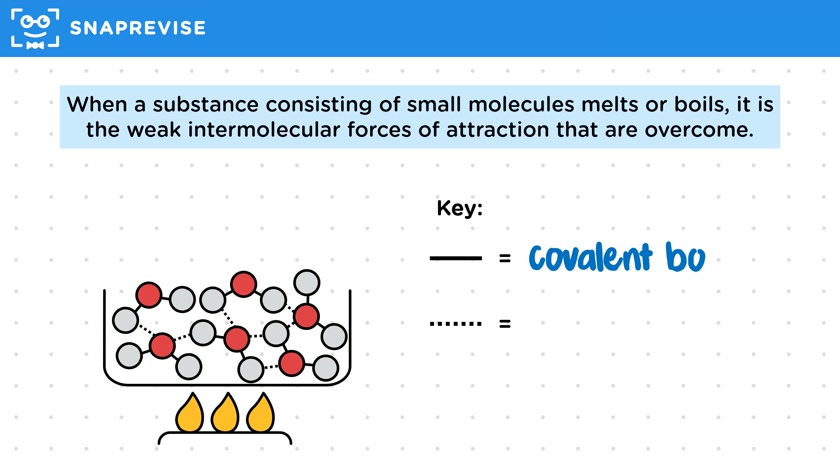
- Strong covalent bonds exist between atoms in a molecule.
- Weak intermolecular forces exist between molecules.
- Melting or boiling involves overcoming weak intermolecular forces.
- Covalent bonds within molecules remain intact during phase changes.
- Substances with small molecules have low melting and boiling points.
- Water has a melting point of 0��C and a boiling point of 100��C.
- Small molecules are often liquids or gases at room temperature.
- Larger molecules have stronger intermolecular forces and higher melting/boiling points.
- Bromine (Br2) and iodine (I2) illustrate size-related boiling point differences.
- Small molecules do not conduct electricity due to lack of overall electric charge.
- Neutral molecules, like oxygen, do not allow charge flow, preventing electrical conduction.
Please subscribe to access these revision notes.
This, and all other video notes, are included in our premium subscriptions.
Premium accounts get access to all videos and revision notes.
55
questions for Organisation
47
questions for Animal Tissues, Organs and Organ Systems