
GCSE Combined Science (AQA)
622 videos | 38 hours
Please subscribe to watch this video.
This, and all other videos, are included in our premium subscriptions.
Premium accounts get access to all videos.
Enable autoplay to keep watching
Your browser is blocking videos from playing automatically. To turn it back on:
Safari (Mac): Click the Safari menu item in the top bar, then Settings → Websites → Auto-Play, then set Auto-Play to Allow All Auto-Play for the current website.
Safari (iPhone/iPad): open the Settings app, then Apps → Safari → Auto-Play, and select Allow All Auto-Play.
Random Nature of Radioactive Decay
- Nuclear decay is a random process; it's unpredictable which nucleus will decay next or when.
- All nuclei in a sample appear the same and decay at random times, which could range from seconds to years.
- It's impossible to predict the exact number of nuclei that will decay in a specific time period.
- Each nucleus has an equal chance of decaying within any given time period.
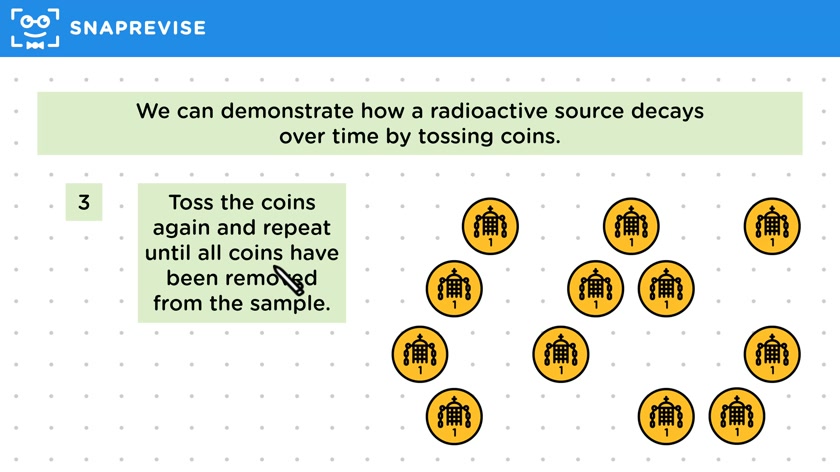
- A coin toss experiment can simulate radioactive decay, with each coin representing an unstable nucleus.
- In the experiment, coins are tossed and those landing on heads are considered decayed and removed from the sample.
- The process is repeated, tossing the remaining coins and removing those that land on heads until none are left.
- Each coin toss represents a time period, and the experiment shows the randomness of decay.
- The number of coins that decay with each toss can be tracked and graphed.
- Although decay is random, probabilities can be assigned to predict how quickly a sample will decay.
- For example, if there's a 20% chance of decay per minute, approximately 20% of nuclei will decay in that time.
- In the coin experiment, each coin has a 50% chance of decaying per toss, predicting that about 50% of the coins will decay each time.
Please subscribe to access these revision notes.
This, and all other video notes, are included in our premium subscriptions.
Premium accounts get access to all videos and revision notes.
111
questions for Atomic structure
71
questions for Atoms and nuclear radiation