
GCSE Combined Science (AQA)
622 videos | 38 hours
Please subscribe to watch this video.
This, and all other videos, are included in our premium subscriptions.
Premium accounts get access to all videos.
Enable autoplay to keep watching
Your browser is blocking videos from playing automatically. To turn it back on:
Safari (Mac): Click the Safari menu item in the top bar, then Settings → Websites → Auto-Play, then set Auto-Play to Allow All Auto-Play for the current website.
Safari (iPhone/iPad): open the Settings app, then Apps → Safari → Auto-Play, and select Allow All Auto-Play.
Rate of Diffusion
- The rate of diffusion refers to how quickly particles spread out.
- Three factors affect the rate of diffusion: concentration gradient, temperature, and surface area of the membrane.
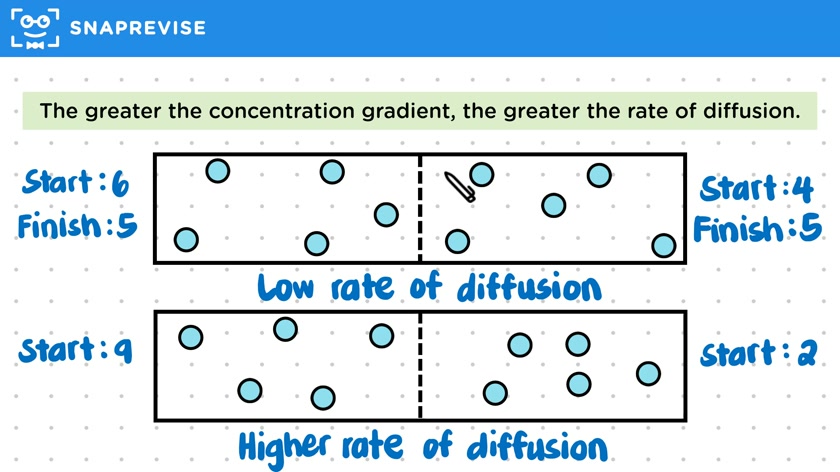
- Concentration gradient is the difference in the concentration of a substance across a membrane.
- Example provided: 6 particles on one side and 4 on the other side of a membrane shows a low concentration gradient.
- A higher concentration gradient (9 particles on one side and 2 on the other) results in a higher rate of diffusion.
- Diffusion moves down the concentration gradient from an area of higher concentration to an area of lower concentration.
- The greater the concentration gradient, the greater the rate of diffusion.
- Temperature also affects the rate of diffusion; higher temperatures increase the rate due to more kinetic energy in particles.
- Surface area of the membrane impacts diffusion; a larger surface area allows for a faster rate of diffusion.
- Surface area to volume ratio (SA/Vol) is crucial; cells with a larger surface area to volume ratio have a higher rate of diffusion.
- In exams, understanding how these factors affect diffusion rates is essential, and using precise terminology like "surface area to volume ratio" can be important for scoring points.
Please subscribe to access these revision notes.
This, and all other video notes, are included in our premium subscriptions.
Premium accounts get access to all videos and revision notes.
135
questions for Cell Biology
64
questions for Transport in Cells