
GCSE Combined Science (AQA)
622 videos | 38 hours
Please subscribe to watch this video.
This, and all other videos, are included in our premium subscriptions.
Premium accounts get access to all videos.
Enable autoplay to keep watching
Your browser is blocking videos from playing automatically. To turn it back on:
Safari (Mac): Click the Safari menu item in the top bar, then Settings → Websites → Auto-Play, then set Auto-Play to Allow All Auto-Play for the current website.
Safari (iPhone/iPad): open the Settings app, then Apps → Safari → Auto-Play, and select Allow All Auto-Play.
Rate of Reaction
- The rate of reaction measures how quickly a reaction occurs.
- Different chemical reactions have varying rates.
- Fireworks demonstrate fast reactions with loud sounds and bright lights.
- Rusting of metals is a slow reaction, taking months or years.
- The rate of a chemical reaction changes as it progresses.
- Example: Metal with acid reaction starts vigorously, indicated by hydrogen bubbles.
- Reaction slows down as metal decreases and acid becomes less concentrated.
- Mean rate of reaction is often calculated.
- Mean rate of reaction can be calculated using:
- Quantity of reactant used divided by time taken.
- Quantity of product formed divided by time taken.
- Measuring reactant loss or product formation helps determine reaction rate.
- Mass is measured in grams, typically for reactant used.
- Volume is measured in centimeters cubed, typically for product gas.
- Time is measured in seconds for rate calculations.
- Units for rate of reaction are grams per second or centimeters cubed per second.
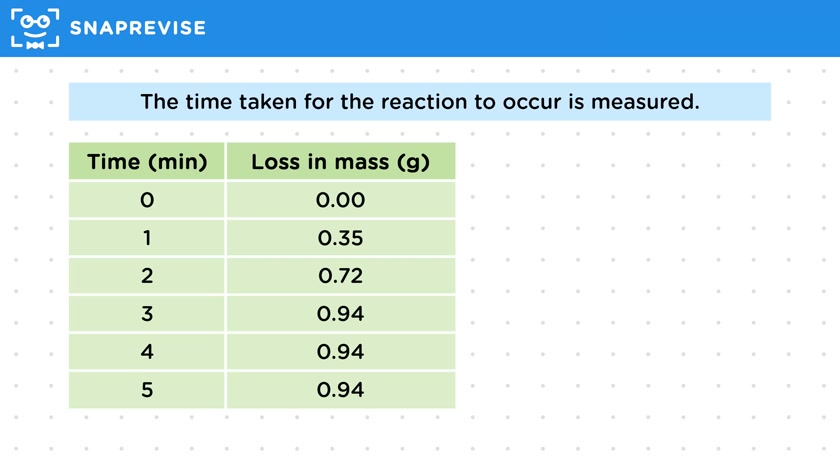
- Example calculation: Mean rate of reaction between magnesium and hydrochloric acid.
- Steps for calculation:
- 1. Write out the equation to be used.
- 2. Identify when the reaction finished and maximum product formed.
- 3. Write down total quantity of product formed and time taken.
- 4. Substitute values into the equation and calculate.
- 5. Check units for the rate of reaction.
- Units for rate should always be given, even if not explicitly asked.
Please subscribe to access these revision notes.
This, and all other video notes, are included in our premium subscriptions.
Premium accounts get access to all videos and revision notes.
46
questions for The rate and extent of chemical change
46
questions for Rate of reaction