
GCSE Combined Science (AQA)
622 videos | 38 hours
Please subscribe to watch this video.
This, and all other videos, are included in our premium subscriptions.
Premium accounts get access to all videos.
Enable autoplay to keep watching
Your browser is blocking videos from playing automatically. To turn it back on:
Safari (Mac): Click the Safari menu item in the top bar, then Settings → Websites → Auto-Play, then set Auto-Play to Allow All Auto-Play for the current website.
Safari (iPhone/iPad): open the Settings app, then Apps → Safari → Auto-Play, and select Allow All Auto-Play.
Resistance in Series
- Increasing the number of resistors in a series circuit increases the total resistance.
- Charge carriers must pass through all resistors in series, losing energy with each resistor they pass through.
- Example provided comparing two circuits with the same type of resistor but different quantities, demonstrating higher resistance with more resistors.
- Total resistance in a series circuit is calculated by summing the resistances of all components.
- Example calculation: A series circuit with two resistors, R1 and R2, has a total resistance of R1 + R2.
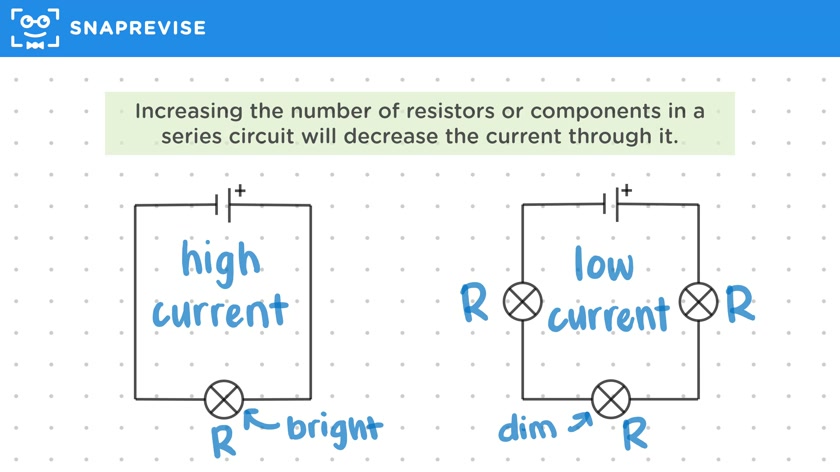
- Higher total resistance in a circuit leads to a decrease in current, as current is inversely proportional to resistance.
- Example provided comparing current flow in circuits with different numbers of lamps, showing lower current with higher resistance.
- Potential difference in a series circuit is split among components based on their resistances.
- Example calculation: In a circuit with a 24-volt cell, a 1-ohm lamp, and a 5-ohm resistor, the potential difference is divided into 4 volts across the lamp and 20 volts across the resistor.
- Detailed example provided calculating total resistance in a circuit with two lamps, using series circuit rules and equations to find unknown values.
- Final resistance calculation example: Adding the resistances of two lamps in series to find the total resistance of the circuit.
Please subscribe to access these revision notes.
This, and all other video notes, are included in our premium subscriptions.
Premium accounts get access to all videos and revision notes.
125
questions for Electricity
29
questions for Series and parallel circuits