
GCSE Combined Science (AQA)
622 videos | 38 hours
Please subscribe to watch this video.
This, and all other videos, are included in our premium subscriptions.
Premium accounts get access to all videos.
Enable autoplay to keep watching
Your browser is blocking videos from playing automatically. To turn it back on:
Safari (Mac): Click the Safari menu item in the top bar, then Settings → Websites → Auto-Play, then set Auto-Play to Allow All Auto-Play for the current website.
Safari (iPhone/iPad): open the Settings app, then Apps → Safari → Auto-Play, and select Allow All Auto-Play.
Forces
Forces and their interactions
Resolving Forces
3:25
Resultant Force
Spec
4.5.1.4
- Resolving a force involves splitting it into two perpendicular components.
- Forces are vectors with magnitude and direction.
- Example: Tension in a pendulum can be resolved into components TV and TH.
- Perpendicular directions are most useful for resolving components.
- The original force is the resultant of its components.
- A scale vector diagram can be used to resolve forces.
- Scale vector diagrams show force vector arrows with lengths proportional to their magnitude.
- Components can be drawn on the diagram as a right-angle triangle with the original force.
- The lengths of the components give their magnitudes.
- GCSE exams do not require knowledge of mathematical methods for resolving forces.
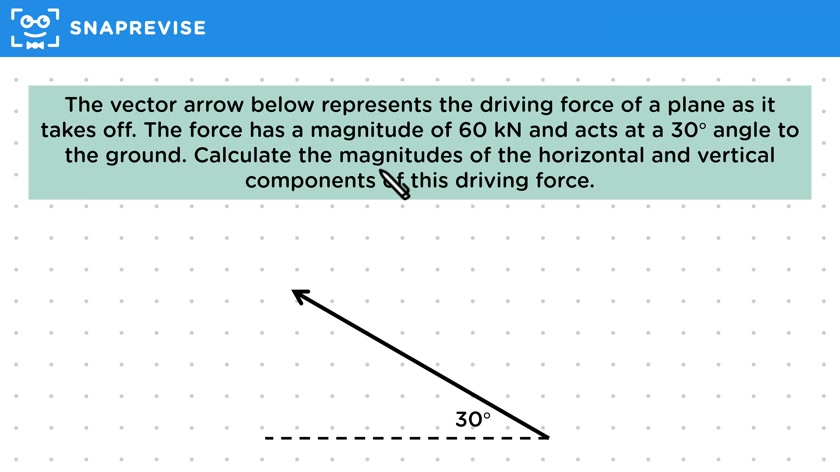
- Example: A plane's driving force of 60 kN at a 30-degree angle can be resolved into horizontal and vertical components.
- Steps for resolving forces:
- 1. Measure the given vector arrow to determine the scale.
- 2. Draw horizontal and vertical forces.
- 3. Measure the lengths of these forces.
- 4. Use the scale to determine the magnitude of these forces.
- Resolving forces is useful for comparing forces on a free body diagram.
- Free body diagrams show all forces acting on an object.
- Resolving forces helps separate and compare horizontal and vertical forces.
- Exam questions may not require resolving forces but might ask to resolve and compare forces in separate questions.
Please subscribe to access these revision notes.
This, and all other video notes, are included in our premium subscriptions.
Premium accounts get access to all videos and revision notes.
Report an Issue
Spotted something wrong? Let us know and we'll take a look.