
GCSE Combined Science (AQA)
622 videos | 38 hours
Please subscribe to watch this video.
This, and all other videos, are included in our premium subscriptions.
Premium accounts get access to all videos.
Enable autoplay to keep watching
Your browser is blocking videos from playing automatically. To turn it back on:
Safari (Mac): Click the Safari menu item in the top bar, then Settings → Websites → Auto-Play, then set Auto-Play to Allow All Auto-Play for the current website.
Safari (iPhone/iPad): open the Settings app, then Apps → Safari → Auto-Play, and select Allow All Auto-Play.
Forces
Forces and their interactions
Scale Vector Diagrams
3:37
Resultant Force
Spec
4.5.1.4
- Forces in a free body diagram are represented as vector arrows.
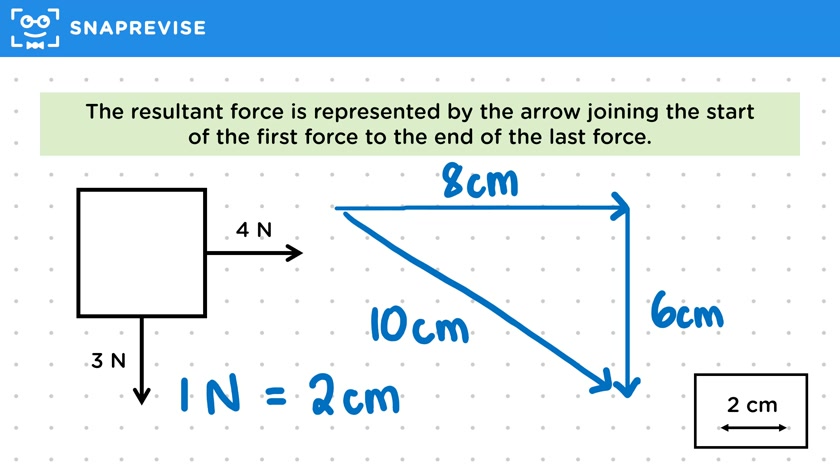
- Scale vector diagrams are used to visually represent forces as arrows, where the length of each arrow is proportional to the magnitude of the force it represents.
- The length of a vector arrow indicates its magnitude, and a suitable scale (e.g., one Newton equals two centimeters) should be chosen to make the diagram clear and easy to convert.
- Resultant force, which is the single force having the same effect as the individual forces combined, is represented by an arrow joining the start of the first force to the end of the last force.
- At GCSE level, students are not expected to mathematically find the resultant of perpendicular forces but can draw the resultant force using a straight line.
- The magnitude and direction of the resultant force can be measured from the scale vector diagram.
- Example provided: A football experiences a six Newton downward gravitational force and a 10 Newton horizontal drag force. Using a scale of one centimeter equals two Newtons, the 10 Newton force is drawn as a five centimeter arrow, and the six Newton force as a three centimeter arrow.
- The resultant force is then drawn and measured using the scale; in this example, it is 5.8 centimeters, which converts to 11.6 Newtons.
- If forces are balanced, the scale vector diagram will form a closed loop, indicating that the net force is zero.
Please subscribe to access these revision notes.
This, and all other video notes, are included in our premium subscriptions.
Premium accounts get access to all videos and revision notes.
Report an Issue
Spotted something wrong? Let us know and we'll take a look.