
GCSE Combined Science (AQA)
622 videos | 38 hours
Please subscribe to watch this video.
This, and all other videos, are included in our premium subscriptions.
Premium accounts get access to all videos.
Enable autoplay to keep watching
Your browser is blocking videos from playing automatically. To turn it back on:
Safari (Mac): Click the Safari menu item in the top bar, then Settings → Websites → Auto-Play, then set Auto-Play to Allow All Auto-Play for the current website.
Safari (iPhone/iPad): open the Settings app, then Apps → Safari → Auto-Play, and select Allow All Auto-Play.
Solids
- Solids are a state of matter where atoms or molecules are tightly packed in a regular, rigid structure.
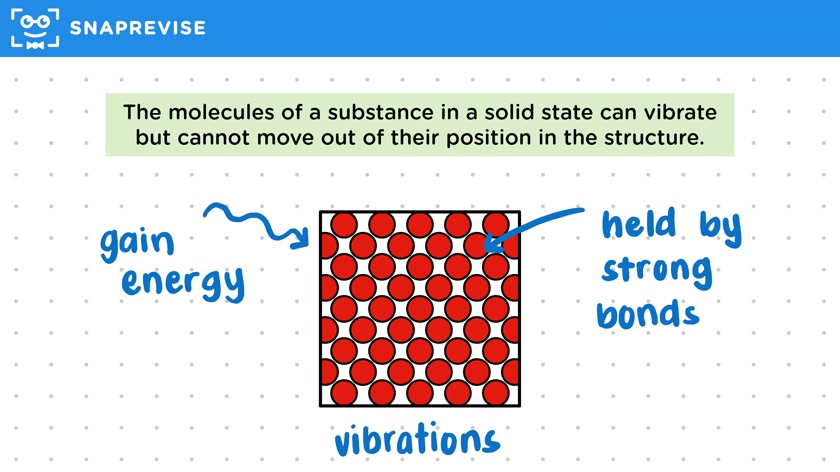
- In solids, molecules can vibrate but cannot move out of their position due to strong bonds.
- Molecules in solids gain energy through heat flow, collisions, and electromagnetic radiation, causing them to vibrate.
- The arrangement of molecules in a solid does not change unless the melting point is reached.
- Solids have a strong structure, making them difficult to change shape, bend, or squash.
- The structure of solids can be altered by cutting, crushing, or processes like wire pulling.
- Changing the state of a solid, such as melting, makes it easier to change its form (e.g., pouring melted metal into molds).
- In exams, examples of substances will clearly indicate their state, allowing for the relation of properties to molecular structure.
Please subscribe to access these revision notes.
This, and all other video notes, are included in our premium subscriptions.
Premium accounts get access to all videos and revision notes.
89
questions for Particle model of matter
34
questions for Changes of state and the particle model