
GCSE Combined Science (AQA)
622 videos | 38 hours
Please subscribe to watch this video.
This, and all other videos, are included in our premium subscriptions.
Premium accounts get access to all videos.
Enable autoplay to keep watching
Your browser is blocking videos from playing automatically. To turn it back on:
Safari (Mac): Click the Safari menu item in the top bar, then Settings → Websites → Auto-Play, then set Auto-Play to Allow All Auto-Play for the current website.
Safari (iPhone/iPad): open the Settings app, then Apps → Safari → Auto-Play, and select Allow All Auto-Play.
Specific Heat Capacity
- Supplying thermal energy to a substance raises its temperature.
- Burning gas can be used to heat water, causing water molecules to move faster and increase temperature.
- More energy supplied results in a greater temperature change.
- Larger flames supply more heat, increasing water temperature further.
- Enough heat can cause water to boil.
- More energy is required to raise the temperature of larger masses of a substance.
- Heat is shared among water molecules; more molecules mean less kinetic energy per molecule, resulting in a smaller temperature increase.
- The mass of water and the amount of heat supplied affect temperature change.
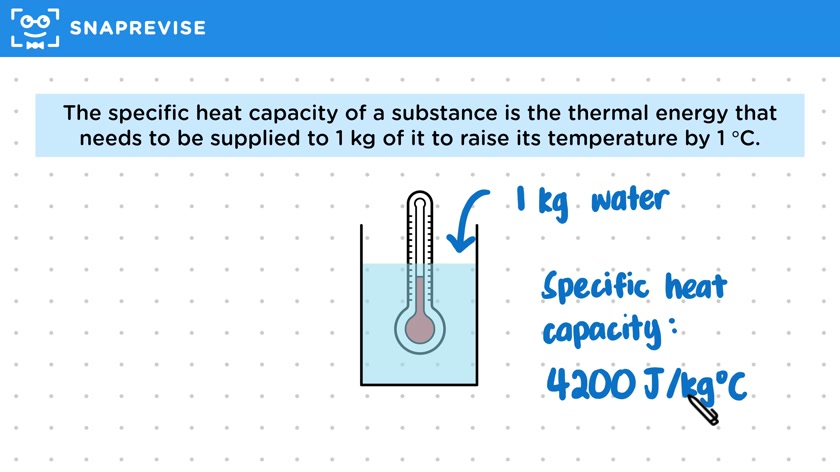
- Specific heat capacity is the thermal energy needed to raise the temperature of one kilogram of a substance by one degree Celsius.
- Water's specific heat capacity is 4,200 joules per kilogram degree Celsius.
- Objects with smaller specific heat capacities require less energy to increase temperature.
- Steel has a low specific heat capacity (450 joules per kilogram degree Celsius) compared to foam (1,300 joules per kilogram degree Celsius).
- Changes of state affect a substance's specific heat capacity.
- Water has different specific heat capacities in different states: ice (2,100 joules per kilogram degree Celsius), liquid water (4,200 joules per kilogram degree Celsius), and water vapor (2,000 joules per kilogram degree Celsius).
Please subscribe to access these revision notes.
This, and all other video notes, are included in our premium subscriptions.
Premium accounts get access to all videos and revision notes.
89
questions for Particle model of matter
44
questions for Internal energy and energy transfers