
GCSE Combined Science (AQA)
622 videos | 38 hours
Please subscribe to watch this video.
This, and all other videos, are included in our premium subscriptions.
Premium accounts get access to all videos.
Enable autoplay to keep watching
Your browser is blocking videos from playing automatically. To turn it back on:
Safari (Mac): Click the Safari menu item in the top bar, then Settings → Websites → Auto-Play, then set Auto-Play to Allow All Auto-Play for the current website.
Safari (iPhone/iPad): open the Settings app, then Apps → Safari → Auto-Play, and select Allow All Auto-Play.
State Symbols
- Balanced symbol equations represent chemical reactions.
- Example: Breakdown of mercury oxide (HGO) into mercury (hg) and oxygen (O2).
- Numbers are added to balance equations.
- State symbols represent states of matter: (s) for solid, (l) for liquid, (g) for gas.
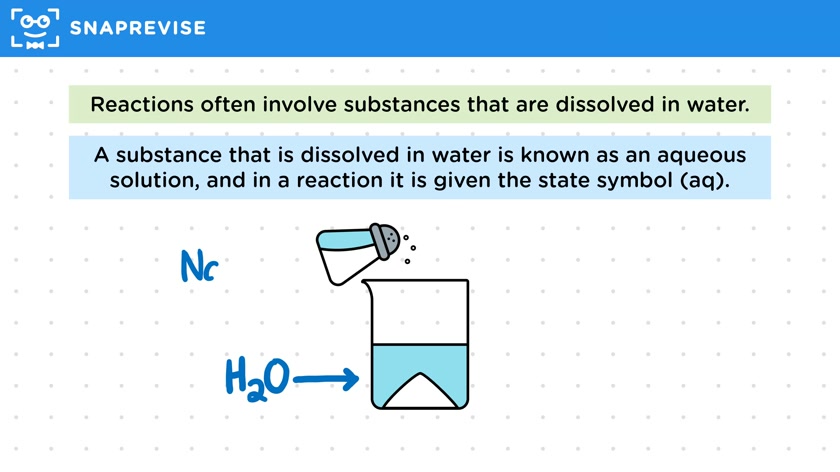
- Aqueous solutions (dissolved in water) are represented by (aq).
- Dissolving is a physical change, not a chemical reaction.
- Example: Lithium reacting with oxygen forms lithium oxide.
- Lithium is a solid (s), oxygen is a gas (g), lithium oxide is a solid (s).
- Example: Lithium reacting with water forms lithium hydroxide and hydrogen gas.
- Lithium is a solid (s), water is a liquid (l), lithium hydroxide is aqueous (aq), hydrogen is a gas (g).
Please subscribe to access these revision notes.
This, and all other video notes, are included in our premium subscriptions.
Premium accounts get access to all videos and revision notes.
28
questions for Bonding, structure, and the properties of matter
11
questions for How bonding and structure are related to the properties of substances