
GCSE Combined Science (AQA)
622 videos | 38 hours
Please subscribe to watch this video.
This, and all other videos, are included in our premium subscriptions.
Premium accounts get access to all videos.
Enable autoplay to keep watching
Your browser is blocking videos from playing automatically. To turn it back on:
Safari (Mac): Click the Safari menu item in the top bar, then Settings → Websites → Auto-Play, then set Auto-Play to Allow All Auto-Play for the current website.
Safari (iPhone/iPad): open the Settings app, then Apps → Safari → Auto-Play, and select Allow All Auto-Play.
Stopping Distance & Speed
- Faster cars have longer stopping distances.
- Stopping distance is the distance traveled between the appearance of a need to stop and the car actually stopping.
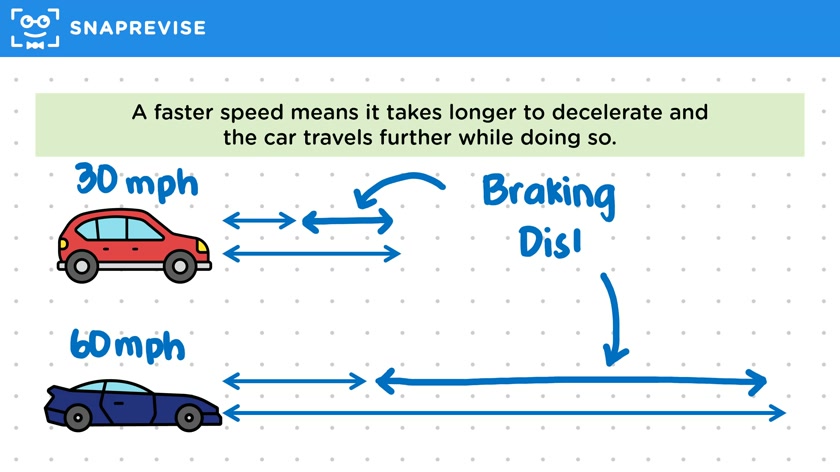
- Two cars with different speeds (30 mph and 60 mph) reacting to the same danger will have different stopping distances.
- Both cars have the same reaction time and braking force; the only difference is their initial speeds.
- Faster car has a longer stopping distance.
- Stopping distance consists of two components: thinking distance and braking distance.
- Thinking distance increases with speed; a faster car travels more distance during the driver's reaction time.
- Reaction time remains constant, but a larger speed results in a larger thinking distance.
- Braking distance also increases with speed; a faster car takes longer to decelerate and travels further.
- Faster car has more speed to lose, resulting in a longer braking distance.
- Stopping distances are considered when determining speed limits.
- Factors influencing speed limits include the chance of sudden hazards, traffic density, junction frequency, and pedestrian crossings.
- Speed limits are set to ensure cars can stop in time to avoid accidents.
- Understanding stopping distances is important for estimating how speed changes affect stopping distances and for explaining speed limits.
Please subscribe to access these revision notes.
This, and all other video notes, are included in our premium subscriptions.
Premium accounts get access to all videos and revision notes.
114
questions for Forces
95
questions for Forces and motion