
GCSE Combined Science (AQA)
622 videos | 38 hours
Please subscribe to watch this video.
This, and all other videos, are included in our premium subscriptions.
Premium accounts get access to all videos.
Enable autoplay to keep watching
Your browser is blocking videos from playing automatically. To turn it back on:
Safari (Mac): Click the Safari menu item in the top bar, then Settings → Websites → Auto-Play, then set Auto-Play to Allow All Auto-Play for the current website.
Safari (iPhone/iPad): open the Settings app, then Apps → Safari → Auto-Play, and select Allow All Auto-Play.
The Water Cycle
- Water is the most abundant liquid on Earth and essential for all cells.
- 71% of the Earth's surface is covered by water.
- The water cycle is crucial for providing fresh water to terrestrial life before it drains into the seas.
- Fresh water comes from precipitation and is utilized by plants and animals on land.
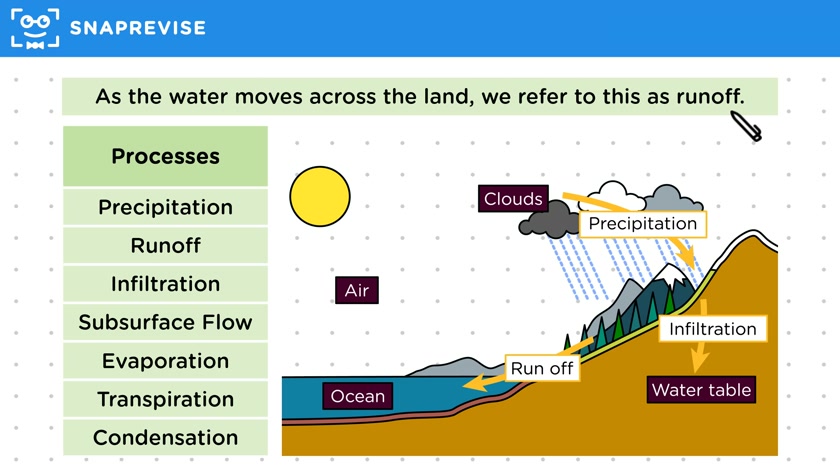
- The water cycle includes processes such as precipitation, runoff, infiltration, subsurface flow, evaporation, transpiration, and condensation.
- Precipitation refers to rain, which leads to runoff, or water moving across the land.
- Infiltration is the process of water seeping into the ground, becoming groundwater.
- Subsurface flow describes the underground movement of groundwater.
- Evaporation is the transformation of liquid water into a gaseous state, usually driven by solar energy.
- Transpiration is the evaporation of water from plant leaves.
- Condensation occurs when gaseous water cools and transforms back into liquid, forming clouds.
- These processes are interconnected, forming a continuous cycle that repeats indefinitely, essential knowledge for exams.
Please subscribe to access these revision notes.
This, and all other video notes, are included in our premium subscriptions.
Premium accounts get access to all videos and revision notes.
18
questions for Ecology
6
questions for Organisation of an Ecosystem