
GCSE Combined Science (AQA)
622 videos | 38 hours
Please subscribe to watch this video.
This, and all other videos, are included in our premium subscriptions.
Premium accounts get access to all videos.
Enable autoplay to keep watching
Your browser is blocking videos from playing automatically. To turn it back on:
Safari (Mac): Click the Safari menu item in the top bar, then Settings → Websites → Auto-Play, then set Auto-Play to Allow All Auto-Play for the current website.
Safari (iPhone/iPad): open the Settings app, then Apps → Safari → Auto-Play, and select Allow All Auto-Play.
Transpiration Stream
- Transpiration is defined as the evaporation of water from the surface of leaves.
- This evaporation leads to water loss from the leaves, causing water to move up the plant in a stream.
- Stomata, controlled by guard cells, open to allow carbon dioxide in, which also facilitates water evaporation from leaf cells.
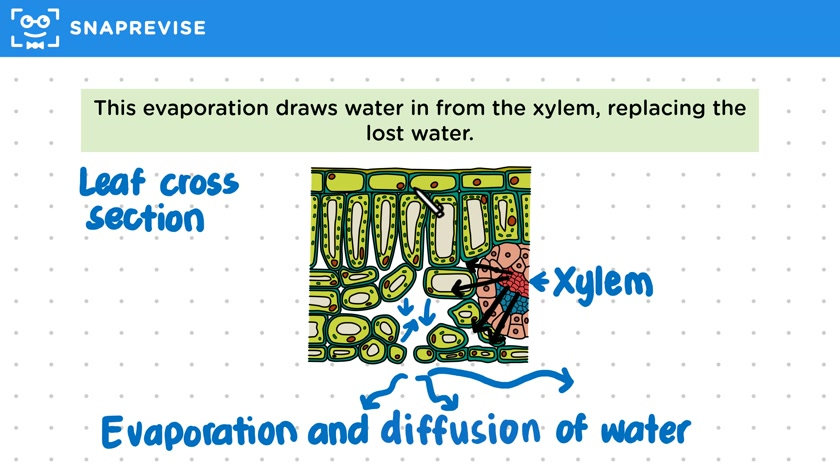
- Water evaporates into air gaps from the spongy mesophyll cells and diffuses out through the stomata.
- Inside the leaf, water diffuses from areas of high water potential to areas of low water potential.
- The loss of water from leaves draws water up from the xylem to replace it.
- The xylem, strengthened by lignin, is a structure through which water and minerals travel, supporting the transpiration stream.
- Water molecules in the xylem are pulled up in a continuous stream due to intermolecular forces, known as cohesion.
- The transpiration effect continues down to the roots, where water lost at the leaves is replaced by osmosis from the soil into the root hair cells.
- Osmosis is defined as the diffusion of water from an area of higher concentration to an area of lower concentration, facilitated by a partially permeable membrane like the cell membrane of root hair cells.
Please subscribe to access these revision notes.
This, and all other video notes, are included in our premium subscriptions.
Premium accounts get access to all videos and revision notes.
55
questions for Organisation
4
questions for Plant Tissues, Organs and Systems