
GCSE Combined Science (AQA)
622 videos | 38 hours
Please subscribe to watch this video.
This, and all other videos, are included in our premium subscriptions.
Premium accounts get access to all videos.
Enable autoplay to keep watching
Your browser is blocking videos from playing automatically. To turn it back on:
Safari (Mac): Click the Safari menu item in the top bar, then Settings → Websites → Auto-Play, then set Auto-Play to Allow All Auto-Play for the current website.
Safari (iPhone/iPad): open the Settings app, then Apps → Safari → Auto-Play, and select Allow All Auto-Play.
Water Ripples
- Water waves can be created and observed in a ripple tank, a common classroom experiment.
- In exams, you may need to analyze the process and results of such experiments.
- A ripple tank setup involves a plank periodically dipped into water, creating waves.
- The plank can be moved by elastic bands or a motor.
- Waves are created as the plank displaces water.
- Waves can be difficult to see directly, so a light source is used to create shadows of the ripples on a screen.
- Shadows correspond to wave peaks, allowing measurement of wave properties.
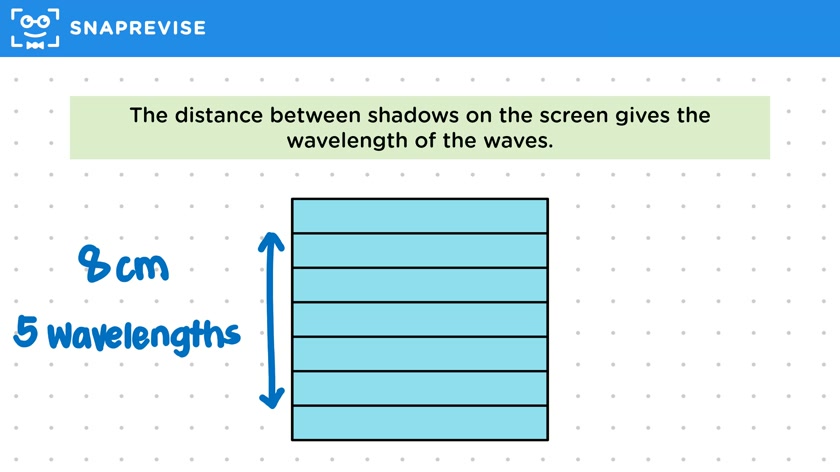
- The distance between shadows gives the wavelength of the waves.
- Wavelength is the distance between two equivalent points on the wave, such as peaks.
- For accuracy, measure between multiple shadows.
- Example: 8 cm distance covers 5 wavelengths, so one wavelength is 1.6 cm.
- Frequency is the number of shadows passing a point per second.
- Example: 2 shadows pass in 5 seconds, frequency is 0.4 Hz.
- Wavelength and frequency can determine wave speed.
- Speed of a wave is the rate of energy transfer or pattern movement.
- Speed is calculated using the equation: Speed = Wavelength x Frequency.
- Example: Wavelength of 1.6 cm and frequency of 0.4 Hz gives speed of 0.64 cm/s.
- Speed can also be measured by timing shadow travel over a distance, verifying the speed equation.
Please subscribe to access these revision notes.
This, and all other video notes, are included in our premium subscriptions.
Premium accounts get access to all videos and revision notes.
82
questions for Waves
38
questions for Waves in air, fluids and solids