
GCSE Combined Science (AQA)
622 videos | 38 hours
Please subscribe to watch this video.
This, and all other videos, are included in our premium subscriptions.
Premium accounts get access to all videos.
Enable autoplay to keep watching
Your browser is blocking videos from playing automatically. To turn it back on:
Safari (Mac): Click the Safari menu item in the top bar, then Settings → Websites → Auto-Play, then set Auto-Play to Allow All Auto-Play for the current website.
Safari (iPhone/iPad): open the Settings app, then Apps → Safari → Auto-Play, and select Allow All Auto-Play.
Work & Elastic Potential
- Elastic deformation involves work done to store energy in a deformed object.
- Work is the transfer of energy when an object is moved by an applied force.
- Deformations occur with multiple forces, including extensions and compressions.
- Stretching a spring is an example of deformation with length change due to equal and opposite forces.
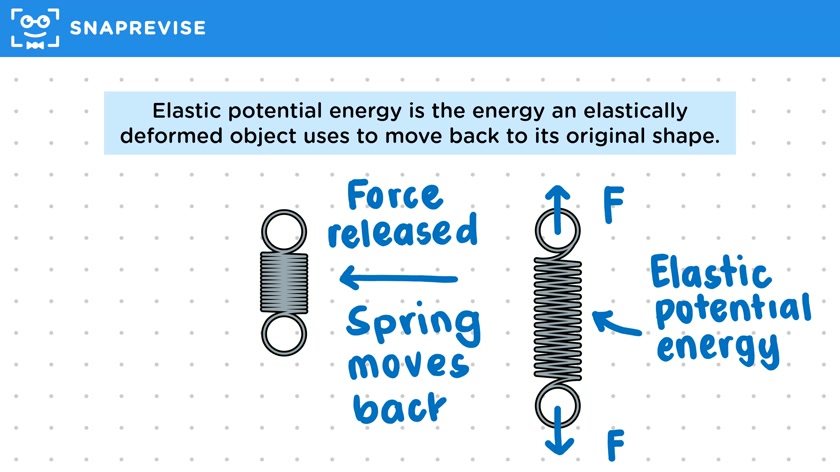
- Work done on a spring stores energy as elastic potential energy.
- Elastic potential energy helps an object return to its original shape.
- Elastic potential energy is stored as bonds try to restore particles to their original shape.
- When force is released, elastic potential energy converts to kinetic energy, moving the spring back.
- Elastic potential energy can be used practically, e.g., in elastic bands or catapults.
- Elastic potential energy is stored by deforming elastic bands or springs and released as kinetic energy.
- Inelastic deformations involve work done to break bonds, causing objects to heat up.
- Inelastic deformations result in permanent deformation, with energy released as heat.
Please subscribe to access these revision notes.
This, and all other video notes, are included in our premium subscriptions.
Premium accounts get access to all videos and revision notes.
114
questions for Forces
1
questions for Forces and elasticity