
GCSE Physics (AQA)
346 videos | 23 hours
Please subscribe to watch this video.
This, and all other videos, are included in our premium subscriptions.
Premium accounts get access to all videos.
Enable autoplay to keep watching
Your browser is blocking videos from playing automatically. To turn it back on:
Safari (Mac): Click the Safari menu item in the top bar, then Settings → Websites → Auto-Play, then set Auto-Play to Allow All Auto-Play for the current website.
Safari (iPhone/iPad): open the Settings app, then Apps → Safari → Auto-Play, and select Allow All Auto-Play.
Calculating Change in Temperature
- The energy change required for a temperature change in a substance depends on its mass and specific heat capacity.
- Specific heat capacity is defined as the amount of heat needed to raise the temperature of one kilogram of a substance by one degree Celsius.
- The formula for change in thermal energy is: ��E = m �� c �� ��T, where ��E is the change in energy, m is mass, c is specific heat capacity, and ��T is the change in temperature.
- Energy is measured in joules, mass in kilograms, and temperature change in degrees Celsius.
- Specific heat capacity is calculated as joules per kilogram per degree Celsius.
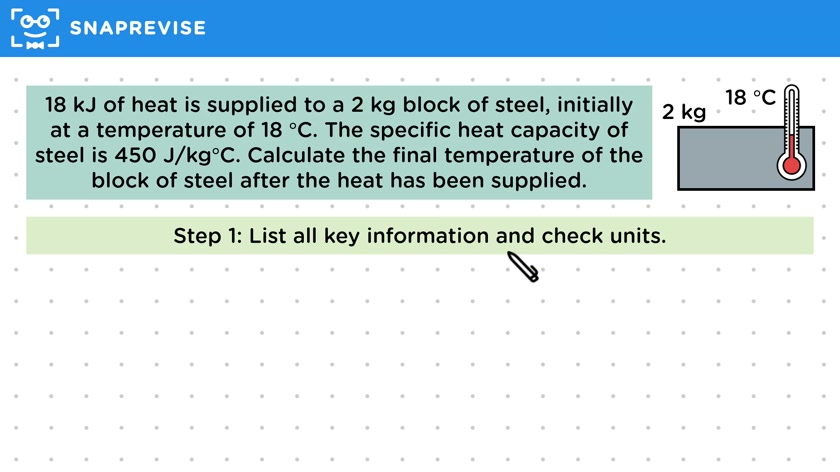
- Example given: 18 kilojoules of heat supplied to a 2 kg block of steel with a specific heat capacity of 450 joules/kg��C, initially at 18��C.
- To find the final temperature, convert the given energy from kilojoules to joules (18,000 joules).
- Rearrange the specific heat capacity formula to solve for the change in temperature: ��T = ��E / (m �� c).
- Substitute values into the rearranged formula to calculate the change in temperature, resulting in a 20��C increase.
- Calculate the final temperature by adding the change in temperature to the initial temperature, resulting in a final temperature of 38��C for the steel block.
Please subscribe to access these revision notes.
This, and all other video notes, are included in our premium subscriptions.
Premium accounts get access to all videos and revision notes.
105
questions for Energy
39
questions for Energy changes in a system, and the ways energy is stored before and after such changes