
GCSE Physics (AQA)
346 videos | 23 hours
Please subscribe to watch this video.
This, and all other videos, are included in our premium subscriptions.
Premium accounts get access to all videos.
Enable autoplay to keep watching
Your browser is blocking videos from playing automatically. To turn it back on:
Safari (Mac): Click the Safari menu item in the top bar, then Settings → Websites → Auto-Play, then set Auto-Play to Allow All Auto-Play for the current website.
Safari (iPhone/iPad): open the Settings app, then Apps → Safari → Auto-Play, and select Allow All Auto-Play.
Forces
Moments, levers and gears (physics only)
Calculating Moments
2:04
Moments
Spec
4.5.4
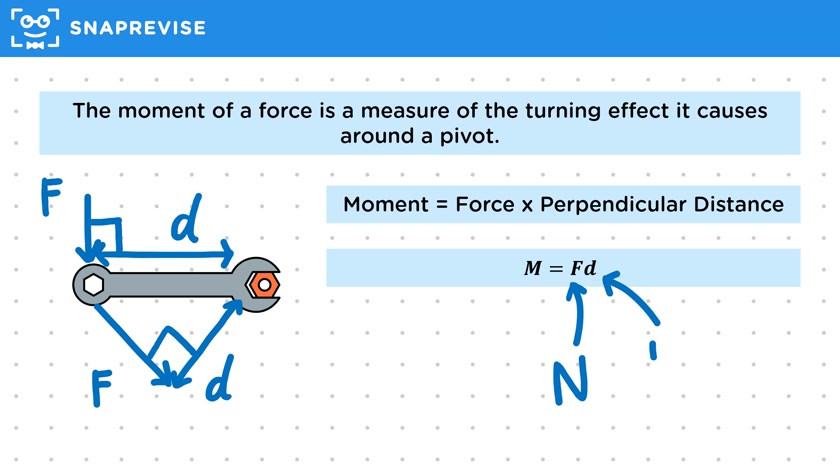
- Moment of a force measures the turning effect around a pivot.
- Forces cause rotation when applied at a distance from a pivot.
- Moment is calculated as force multiplied by perpendicular distance (M = F x D).
- Distance is measured from the pivot to the point of action of the perpendicular force.
- Non-perpendicular forces result in shorter distances and smaller moments.
- A force directed through a pivot creates no rotation (perpendicular distance is zero).
- GCSE exam problems will involve clear perpendicular forces.
- Force is measured in Newtons, distance in meters, and moment in Newton meters.
- Example: Calculate the moment caused by a 6 Newton force at corner C of a rectangular sheet.
- Step 1: Determine the perpendicular distance (2 meters).
- Step 2: Substitute values into the moment equation (Moment = 6 Newtons x 2 meters = 12 Newton meters).
Please subscribe to access these revision notes.
This, and all other video notes, are included in our premium subscriptions.
Premium accounts get access to all videos and revision notes.
Report an Issue
Spotted something wrong? Let us know and we'll take a look.