
GCSE Physics (AQA)
346 videos | 23 hours
Please subscribe to watch this video.
This, and all other videos, are included in our premium subscriptions.
Premium accounts get access to all videos.
Enable autoplay to keep watching
Your browser is blocking videos from playing automatically. To turn it back on:
Safari (Mac): Click the Safari menu item in the top bar, then Settings → Websites → Auto-Play, then set Auto-Play to Allow All Auto-Play for the current website.
Safari (iPhone/iPad): open the Settings app, then Apps → Safari → Auto-Play, and select Allow All Auto-Play.
Calculating Power
- Power depends on energy transferred or work done and the time taken.
- Power equation: Power (P) = Energy transferred (E) / Time (T).
- Work done is the energy transferred when a force moves an object a certain distance.
- Power can also be expressed as: Power (P) = Work done (W) / Time (T).
- Power is measured in watts (W), time in seconds (S), and energy in joules (J).
- One watt is the power of a process that transfers one joule of energy in one second.
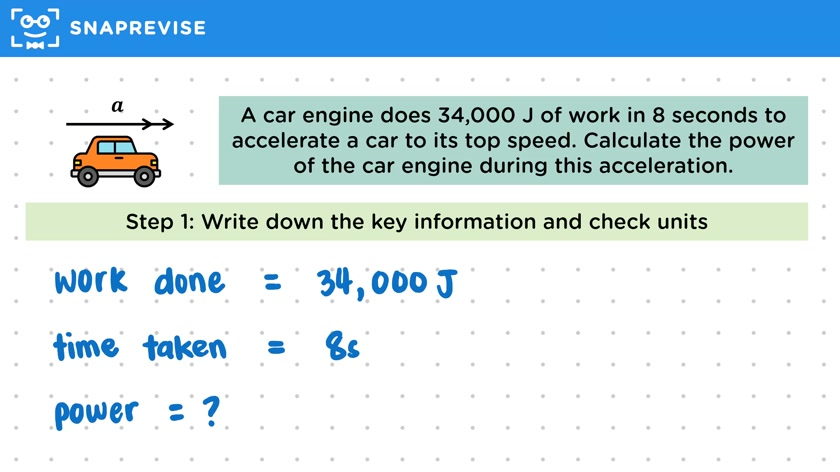
- Example 1: Car engine does 34,000 joules of work in 8 seconds to accelerate.
- Power calculation: Power = 34,000 J / 8 s = 4,250 W.
- Example 2: A 2,400 W kettle takes 4 minutes to boil a liter of water.
- Convert time: 4 minutes = 240 seconds.
- Energy calculation: Energy transferred = Power x Time = 2,400 W x 240 s = 576,000 J.
Please subscribe to access these revision notes.
This, and all other video notes, are included in our premium subscriptions.
Premium accounts get access to all videos and revision notes.
88
questions for Energy
22
questions for Energy changes in a system, and the ways energy is stored before and after such changes