
GCSE Physics (AQA)
346 videos | 23 hours
Please subscribe to watch this video.
This, and all other videos, are included in our premium subscriptions.
Premium accounts get access to all videos.
Enable autoplay to keep watching
Your browser is blocking videos from playing automatically. To turn it back on:
Safari (Mac): Click the Safari menu item in the top bar, then Settings → Websites → Auto-Play, then set Auto-Play to Allow All Auto-Play for the current website.
Safari (iPhone/iPad): open the Settings app, then Apps → Safari → Auto-Play, and select Allow All Auto-Play.
Electric Charge
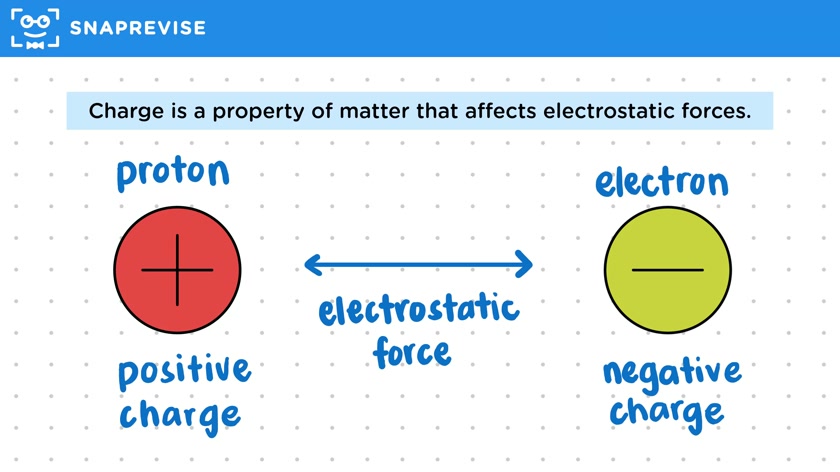
- Charge is a property of matter affecting electrostatic forces.
- Charge is intrinsic and occurs naturally, similar to mass.
- Almost all subatomic particles have charge.
- Protons have a positive charge; electrons have a negative charge.
- Charge gives rise to a force between particles, known as electrostatic force.
- Electrostatic force is an attraction between particles with opposite charges.
- Neutrons have no charge.
- Electrostatic forces are observed between charged objects like protons and electrons.
- Charge is measured in kloss.
- A proton has a charge of +1.6 x 10^-19 kloss.
- An electron has a charge of -1.6 x 10^-19 kloss.
- The charges of a proton and an electron are equal and opposite.
- Protons have a positive charge; electrons have a negative charge.
- An atom has a charge of zero kloss as the charges cancel out.
Please subscribe to access these revision notes.
This, and all other video notes, are included in our premium subscriptions.
Premium accounts get access to all videos and revision notes.
144
questions for Electricity
48
questions for Current, potential difference and resistance