
GCSE Physics (AQA)
346 videos | 23 hours
Please subscribe to watch this video.
This, and all other videos, are included in our premium subscriptions.
Premium accounts get access to all videos.
Enable autoplay to keep watching
Your browser is blocking videos from playing automatically. To turn it back on:
Safari (Mac): Click the Safari menu item in the top bar, then Settings → Websites → Auto-Play, then set Auto-Play to Allow All Auto-Play for the current website.
Safari (iPhone/iPad): open the Settings app, then Apps → Safari → Auto-Play, and select Allow All Auto-Play.
EM Waves & Surfaces
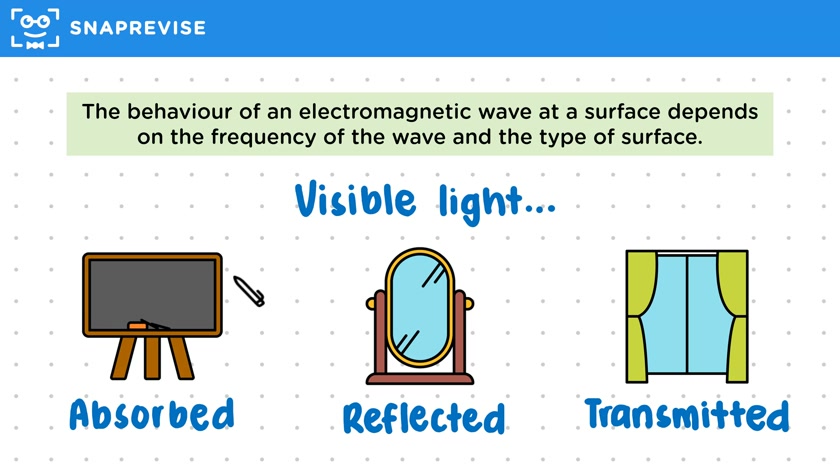
- The behavior of electromagnetic waves at a surface depends on the wave's frequency and the type of surface.
- Frequency determines the type of electromagnetic wave (e.g., ultraviolet, microwave, radio wave) and the color of visible light.
- Blue light is reflected by a blue T-shirt, allowing us to perceive its color, while red light is absorbed.
- High-frequency gamma waves pass through the shirt without effect.
- Predicting EM wave behavior outside visible light is not typically expected.
- Different surfaces interact with visible light differently: blackboards absorb light, mirrors reflect it, and windows transmit it.
- EM waves can exhibit multiple behaviors on surfaces, such as partial reflection.
- Understanding EM wave behaviors is crucial for selecting wavelengths and materials for specific applications.
- Microwaves are used in ovens because they are absorbed by water molecules in food, heating it.
- Polished thin metal can block most EM waves by reflection, but gamma waves require thick lead for protection.
- Rooms for scientific experiments and X-ray scans are lined with thick metal for safety.
- Knowing possible EM wave behaviors and their applications is important for exams.
Please subscribe to access these revision notes.
This, and all other video notes, are included in our premium subscriptions.
Premium accounts get access to all videos and revision notes.
172
questions for Waves
81
questions for Electromagnetic waves