
GCSE Physics (AQA)
346 videos | 23 hours
Please subscribe to watch this video.
This, and all other videos, are included in our premium subscriptions.
Premium accounts get access to all videos.
Enable autoplay to keep watching
Your browser is blocking videos from playing automatically. To turn it back on:
Safari (Mac): Click the Safari menu item in the top bar, then Settings → Websites → Auto-Play, then set Auto-Play to Allow All Auto-Play for the current website.
Safari (iPhone/iPad): open the Settings app, then Apps → Safari → Auto-Play, and select Allow All Auto-Play.
Frequency-Period Relation
- Wave patterns can be described using frequency or period.
- Diagram of a transverse wave shows matter displacement as the pattern moves.
- Frequency is how often peaks pass a line in one second.
- Example: Two peaks per second indicate a frequency of two.
- Period is the time it takes for a full cycle of the wave to pass a line.
- Example: Half a second for a peak indicates the period.
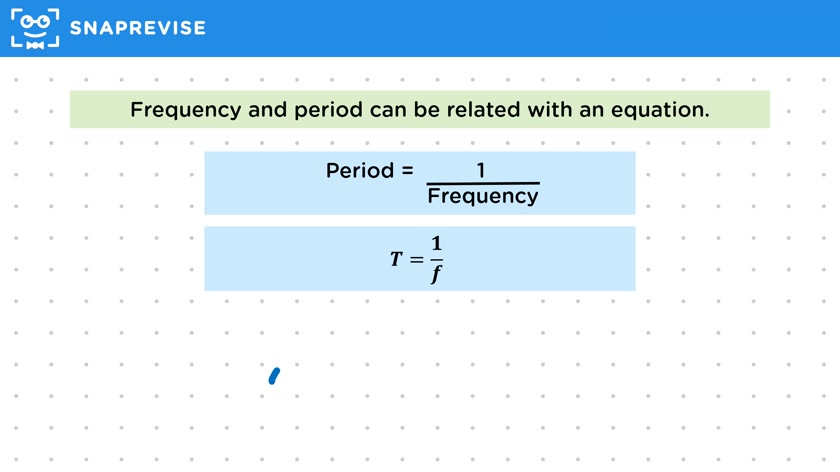
- Frequency and period are mathematically related: period = 1/frequency.
- If frequency decreases, period increases.
- Algebraic equation: T = 1/F, where T is period and F is frequency.
- Period measured in seconds, frequency in hertz.
- Hertz equals 1/seconds.
- A wave with 1 hertz frequency has a period of 1 second.
- Practice question: Calculate period of a sound wave with 2 kilohertz frequency.
- Convert kilohertz to hertz: 2 kilohertz = 2000 hertz.
- Use equation: period = 1/2000 = 0.0005 seconds.
- Importance of unit conversions for exams.
- Be comfortable converting between period and frequency and understanding their relationship.
Please subscribe to access these revision notes.
This, and all other video notes, are included in our premium subscriptions.
Premium accounts get access to all videos and revision notes.
172
questions for Waves
72
questions for Waves in air, fluids and solids