
GCSE Physics (AQA)
346 videos | 23 hours
Please subscribe to watch this video.
This, and all other videos, are included in our premium subscriptions.
Premium accounts get access to all videos.
Enable autoplay to keep watching
Your browser is blocking videos from playing automatically. To turn it back on:
Safari (Mac): Click the Safari menu item in the top bar, then Settings → Websites → Auto-Play, then set Auto-Play to Allow All Auto-Play for the current website.
Safari (iPhone/iPad): open the Settings app, then Apps → Safari → Auto-Play, and select Allow All Auto-Play.
Magnification
- Magnification measures how large an image is compared to an object.
- Lenses can produce real or virtual images by refracting light.
- Real images form when light converges on a screen; virtual images form when light diverges.
- Magnification can be determined without forming an image by using ray diagrams.
- Ray diagrams show how light rays pass through a lens and converge to form an image.
- The height of arrows in ray diagrams represents the object and image sizes.
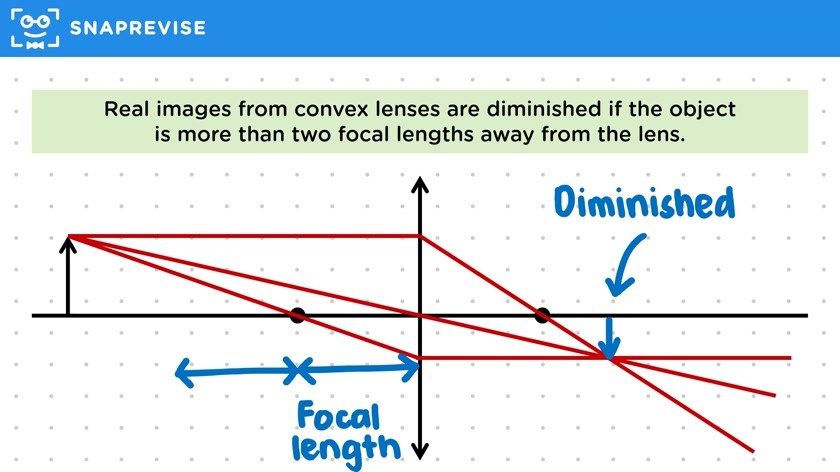
- Real images from convex lenses are diminished if the object is more than two focal lengths away.
- Real images from convex lenses are magnified if the object is between one and two focal lengths away.
- Virtual images from convex lenses are always magnified when the object is less than one focal length away.
- Virtual images from concave lenses are always diminished.
- Convex lenses can create large virtual images when the object is between the lens and its focus.
- Convex lenses create real, magnified images when the object is between one and two focal lengths.
- Convex lenses create diminished real images when the object is more than two focal lengths away.
- Concave lenses always produce diminished images regardless of object distance.
- Understanding how lenses affect image size is important for applications like cameras, projectors, magnifying glasses, and telescopes.
- It's important to be able to demonstrate image formation using ray diagrams for exams.
Please subscribe to access these revision notes.
This, and all other video notes, are included in our premium subscriptions.
Premium accounts get access to all videos and revision notes.
172
questions for Waves
81
questions for Electromagnetic waves