
GCSE Physics (AQA)
346 videos | 23 hours
Please subscribe to watch this video.
This, and all other videos, are included in our premium subscriptions.
Premium accounts get access to all videos.
Enable autoplay to keep watching
Your browser is blocking videos from playing automatically. To turn it back on:
Safari (Mac): Click the Safari menu item in the top bar, then Settings → Websites → Auto-Play, then set Auto-Play to Allow All Auto-Play for the current website.
Safari (iPhone/iPad): open the Settings app, then Apps → Safari → Auto-Play, and select Allow All Auto-Play.
Forces
Moments, levers and gears (physics only)
Using Principle of Moments
3:18
Moments
Spec
4.5.4
- A balanced system uses the principle of moments to understand forces.
- The principle of moments states a system is balanced when total clockwise moment equals total anti-clockwise moment.
- Equation: Total clockwise moment = Total anti-clockwise moment.
- Example: Anti-clockwise moment = F1 x D1; Clockwise moment = F2 x D2.
- Principle of moments: F1 x D1 = F2 x D2.
- In exams, identify when to use the principle of moments.
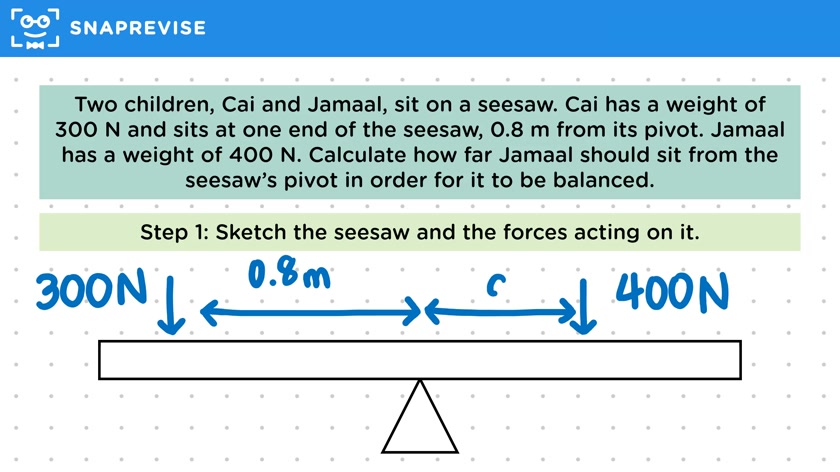
- Example problem: Two children on a seesaw, Kai (300 N) at 0.8 m from pivot, Jamal (400 N) distance unknown.
- Step 1: Sketch seesaw and forces.
- Jamal needs to be closer to the pivot to balance the seesaw.
- Step 2: Calculate Kai's moment: 300 N x 0.8 m = 240 Nm.
- Step 3: Jamal's moment equals Kai's moment (240 Nm).
- Step 4: Rearrange moment equation to solve for distance: Moment/Force = Distance.
- Step 5: Calculate distance: 240 Nm / 400 N = 0.6 m.
Please subscribe to access these revision notes.
This, and all other video notes, are included in our premium subscriptions.
Premium accounts get access to all videos and revision notes.
Report an Issue
Spotted something wrong? Let us know and we'll take a look.