
GCSE Physics (AQA)
346 videos | 23 hours
Please subscribe to watch this video.
This, and all other videos, are included in our premium subscriptions.
Premium accounts get access to all videos.
Enable autoplay to keep watching
Your browser is blocking videos from playing automatically. To turn it back on:
Safari (Mac): Click the Safari menu item in the top bar, then Settings → Websites → Auto-Play, then set Auto-Play to Allow All Auto-Play for the current website.
Safari (iPhone/iPad): open the Settings app, then Apps → Safari → Auto-Play, and select Allow All Auto-Play.
Work Done by Braking Force
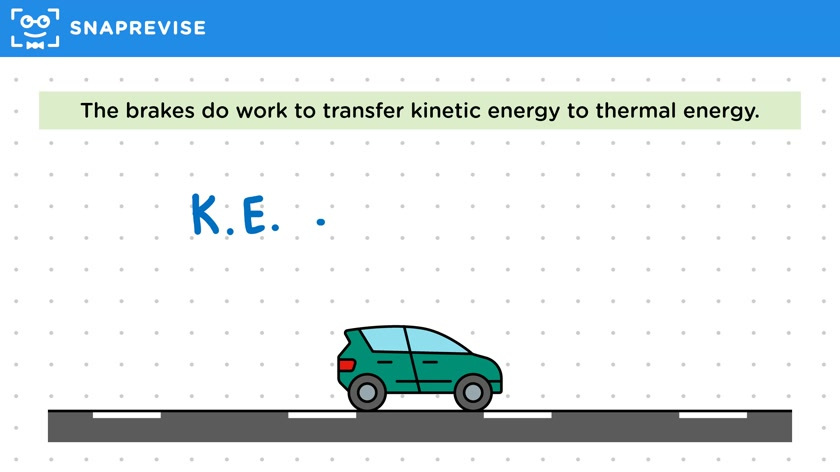
- A braking force reduces the kinetic energy (KE) of a moving car.
- Kinetic energy is the energy possessed by moving objects; more speed equals more kinetic energy.
- Braking force, created by the brakes stopping the car's tires from spinning, generates friction with the road.
- This force is resistive and directed opposite to the car's motion, causing deceleration.
- Deceleration leads to a decrease in the car's speed and its kinetic energy.
- Kinetic energy is not destroyed but transferred, primarily into thermal energy during braking.
- The work done by the braking force converts the car's kinetic energy into thermal energy, which heats the brakes and the road.
- The brakes heat up due to the energy transfer, and this heat can dissipate into the surroundings when the brakes are released.
- Understanding the process of braking in cars illustrates the fundamental principles of force, motion, and energy transfer.
Please subscribe to access these revision notes.
This, and all other video notes, are included in our premium subscriptions.
Premium accounts get access to all videos and revision notes.
153
questions for Forces
98
questions for Forces and motion