
GCSE Physics (AQA)
346 videos | 23 hours
Please subscribe to watch this video.
This, and all other videos, are included in our premium subscriptions.
Premium accounts get access to all videos.
Enable autoplay to keep watching
Your browser is blocking videos from playing automatically. To turn it back on:
Safari (Mac): Click the Safari menu item in the top bar, then Settings → Websites → Auto-Play, then set Auto-Play to Allow All Auto-Play for the current website.
Safari (iPhone/iPad): open the Settings app, then Apps → Safari → Auto-Play, and select Allow All Auto-Play.
100% Efficient Transformer
- A 100% efficient transformer transfers all electrical power from the primary to the secondary coil.
- Transformers change input alternating current to output alternating current with a different potential difference.
- The ratio of potential differences is the same as the ratio of turns in the coils.
- Transformer efficiency is the amount of electrical energy transferred from the primary to the secondary coil.
- A transformer is 100% efficient if there are no energy losses.
- Input power equals output power in a 100% efficient transformer, measured in watts.
- For 100% efficient transformers, the equation VP * IP = VS * IS can be used, where VP and VS are potential differences, and IP and IS are currents.
- The equation P = V * I applies to both direct and alternating currents.
- In a transformer, input power is the product of current and potential difference in the primary coil, and output power is the same for the secondary coil.
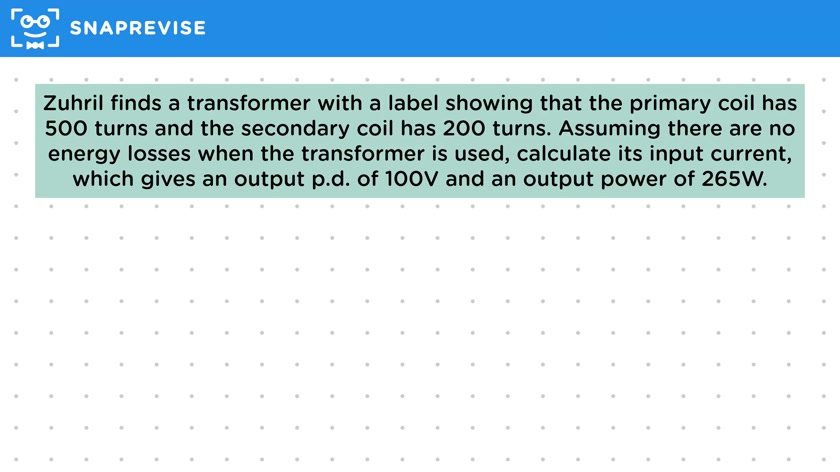
- Example problem: Calculate input current given turns in coils, output potential difference, and output power.
- Steps to solve: List known/unknown variables, rearrange equations, calculate missing values, and substitute to find the desired value.
- No transformer is truly 100% efficient due to energy losses like heat from resistance and magnetizing the iron core.
- Transformers in industry and the national grid are nearly 100% efficient, often assumed to be so for calculations.
- Transformers in the national grid lower current and raise potential difference to reduce heat loss during long-distance transmission.
- Transformers are designed with special cores and low resistance coils to minimize energy losses, achieving about 99% efficiency.
Please subscribe to access these revision notes.
This, and all other video notes, are included in our premium subscriptions.
Premium accounts get access to all videos and revision notes.
99
questions for Magnetism and electromagnetism
38
questions for Induced potential, transformers and the National Grid (physics only) (HT only)