
GCSE Physics (AQA)
346 videos | 23 hours
Please subscribe to watch this video.
This, and all other videos, are included in our premium subscriptions.
Premium accounts get access to all videos.
Enable autoplay to keep watching
Your browser is blocking videos from playing automatically. To turn it back on:
Safari (Mac): Click the Safari menu item in the top bar, then Settings → Websites → Auto-Play, then set Auto-Play to Allow All Auto-Play for the current website.
Safari (iPhone/iPad): open the Settings app, then Apps → Safari → Auto-Play, and select Allow All Auto-Play.
Acceleration & Deceleration
- Acceleration is the rate of change of velocity.
- Velocity is a vector quantity indicating speed and direction.
- Acceleration is also a vector quantity, showing how velocity changes over time.
- An accelerating object gains speed.
- Example: A car starts moving slowly and ends moving quickly, indicating acceleration.
- Visual representation: Longer vector arrow for ending velocity.
- Arrows with double arrowheads can represent accelerations.
- Acceleration in the same direction as velocity increases velocity (positive acceleration).
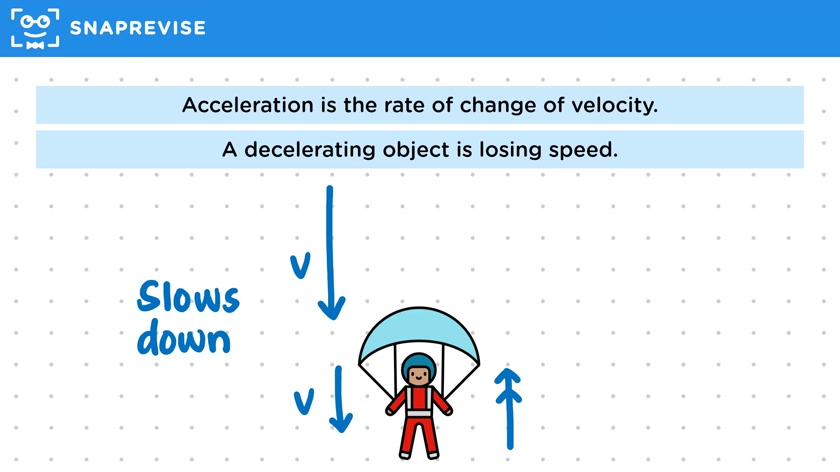
- A decelerating object loses speed.
- Example: A skydiver with a parachute slows down, showing negative acceleration.
- Acceleration vector opposite to velocity vector indicates negative acceleration.
- Acceleration's effect on velocity depends on its direction relative to velocity.
- Greater acceleration results in faster speed gain.
- Magnitude of acceleration affects velocity change.
- Example: A truck takes 60 seconds to reach 60 mph, while a sports car takes 5 seconds, indicating greater acceleration for the car.
- For exams, identify if an object is accelerating or decelerating and explain effects on velocity.
- Compare accelerations of two objects.
Please subscribe to access these revision notes.
This, and all other video notes, are included in our premium subscriptions.
Premium accounts get access to all videos and revision notes.
321
questions for Forces
115
questions for Forces and motion