
GCSE Physics (AQA)
346 videos | 23 hours
Please subscribe to watch this video.
This, and all other videos, are included in our premium subscriptions.
Premium accounts get access to all videos.
Enable autoplay to keep watching
Your browser is blocking videos from playing automatically. To turn it back on:
Safari (Mac): Click the Safari menu item in the top bar, then Settings → Websites → Auto-Play, then set Auto-Play to Allow All Auto-Play for the current website.
Safari (iPhone/iPad): open the Settings app, then Apps → Safari → Auto-Play, and select Allow All Auto-Play.
Alpha Particles
- An alpha particle consists of two protons and two neutrons.
- It is equivalent to a helium nucleus without electrons.
- Large, unstable nuclei release alpha particles to become more stable.
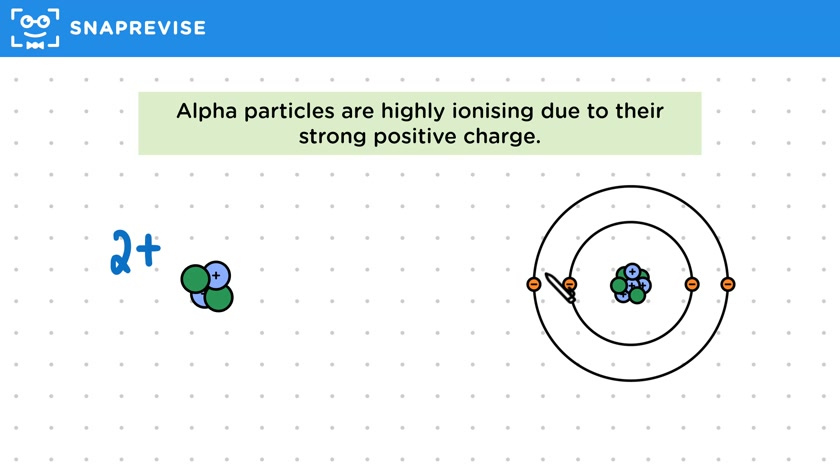
- Alpha particles are highly ionizing due to their strong positive charge.
- Ionization occurs when atoms become ions by gaining or losing electrons.
- Alpha particles have a charge of two plus, containing two protons and no electrons.
- Alpha particles can only travel about five centimeters in air.
- They lose energy quickly due to collisions and ionization.
- Alpha particles can ionize air molecules without direct contact.
- Alpha particles are stopped by a thin sheet of paper or most solids.
- A sheet of paper less than one millimeter thick can stop alpha particles.
Please subscribe to access these revision notes.
This, and all other video notes, are included in our premium subscriptions.
Premium accounts get access to all videos and revision notes.
137
questions for Atomic structure
71
questions for Atoms and nuclear radiation