
GCSE Physics (AQA)
346 videos | 23 hours
Please subscribe to watch this video.
This, and all other videos, are included in our premium subscriptions.
Premium accounts get access to all videos.
Enable autoplay to keep watching
Your browser is blocking videos from playing automatically. To turn it back on:
Safari (Mac): Click the Safari menu item in the top bar, then Settings → Websites → Auto-Play, then set Auto-Play to Allow All Auto-Play for the current website.
Safari (iPhone/iPad): open the Settings app, then Apps → Safari → Auto-Play, and select Allow All Auto-Play.
Angle of Incidence & Reflection
- Reflection can be investigated using a ray box and a plain mirror.
- Reflection occurs when a wave reaches a boundary between two different media and bounces off it.
- A mirror is a flat and polished surface that makes reflections controlled and easier to observe.
- A ray box produces a thin beam of light that travels in a single direction.
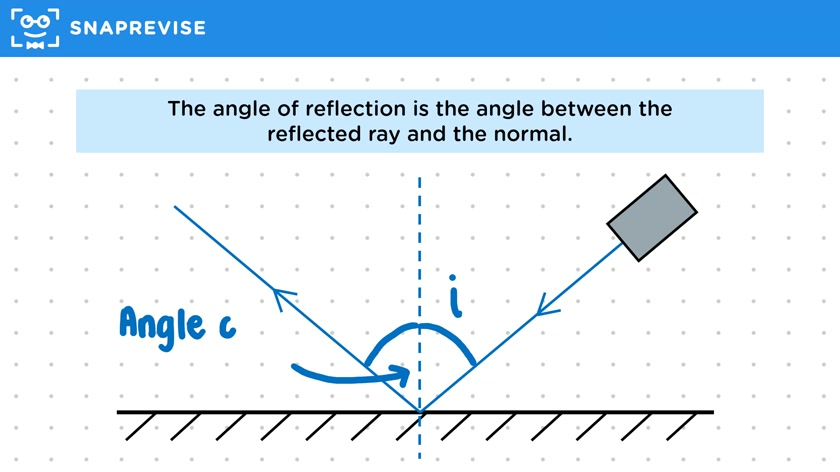
- The ray directed at the mirror is called the incident ray, and the ray reflecting off the mirror is the reflected ray.
- The normal is a line drawn at 90 degrees to the reflective surface.
- The angle of incidence is the angle between the incident ray and the normal.
- The angle of reflection is the angle between the reflected ray and the normal.
- The law of reflection states that the angle of incidence is equal to the angle of reflection (I = R).
- This law applies to all waves, not just light rays.
- Echoing is a type of reflection of sound waves off a building.
- Sound waves spread out and hit the building at different points, reflecting in various directions, including back towards the source.
Please subscribe to access these revision notes.
This, and all other video notes, are included in our premium subscriptions.
Premium accounts get access to all videos and revision notes.
172
questions for Waves
72
questions for Waves in air, fluids and solids