
GCSE Physics (AQA)
346 videos | 23 hours
Please subscribe to watch this video.
This, and all other videos, are included in our premium subscriptions.
Premium accounts get access to all videos.
Enable autoplay to keep watching
Your browser is blocking videos from playing automatically. To turn it back on:
Safari (Mac): Click the Safari menu item in the top bar, then Settings → Websites → Auto-Play, then set Auto-Play to Allow All Auto-Play for the current website.
Safari (iPhone/iPad): open the Settings app, then Apps → Safari → Auto-Play, and select Allow All Auto-Play.
Atmospheric Pressure
- Atmospheric pressure is the force exerted by air particles in the atmosphere.
- Air pressure results from gas particles colliding with objects.
- At Earth's surface, atmospheric pressure is about one atmosphere or around 100 kilo pascals.
- Humans typically don't feel atmospheric pressure due to body adaptation, unless in high or low pressure environments.
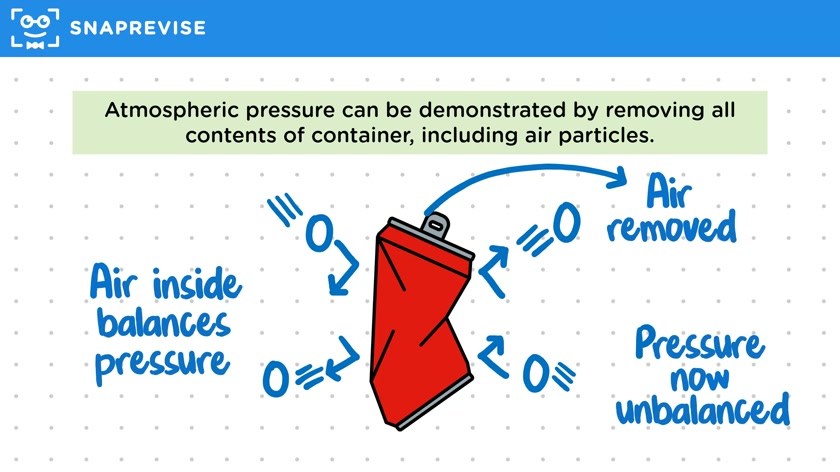
- Atmospheric pressure's existence can be demonstrated by removing air from a container, showing that pressure inside balances the external pressure until the air is removed, causing the container to crumple due to unbalanced external pressure.
- The strength of atmospheric pressure varies with altitude; it decreases as distance from Earth increases due to fewer air molecules and less gravitational pull.
- Atmospheric pressure also changes with weather conditions and can vary at different points on the Earth's surface due to factors like humidity.
- Significant differences in atmospheric pressure are noticeable when flying or at high altitudes such as mountain peaks.
- At heights like those of airplanes or Mount Everest (8,000 to 10,000 meters above sea level), the pressure can drop to about 0.3 atmospheres.
- Adaptations like pressurized airplane cabins and oxygen supplies for climbers are necessary due to the low atmospheric pressure at high altitudes.
- Understanding and comparing atmospheric pressures at different altitudes is important for contexts such as exams.
Please subscribe to access these revision notes.
This, and all other video notes, are included in our premium subscriptions.
Premium accounts get access to all videos and revision notes.
153
questions for Forces
19
questions for Pressure and pressure differences in fluids (physics only)