
GCSE Physics (AQA)
346 videos | 23 hours
Please subscribe to watch this video.
This, and all other videos, are included in our premium subscriptions.
Premium accounts get access to all videos.
Enable autoplay to keep watching
Your browser is blocking videos from playing automatically. To turn it back on:
Safari (Mac): Click the Safari menu item in the top bar, then Settings → Websites → Auto-Play, then set Auto-Play to Allow All Auto-Play for the current website.
Safari (iPhone/iPad): open the Settings app, then Apps → Safari → Auto-Play, and select Allow All Auto-Play.
Beta Particles
- A beta particle is a type of radiation consisting of a fast-moving electron ejected from a nucleus.
- It is released from an atom with too many neutrons.
- A beta particle is the same as a free electron.
- It is emitted when a neutron turns into a proton.
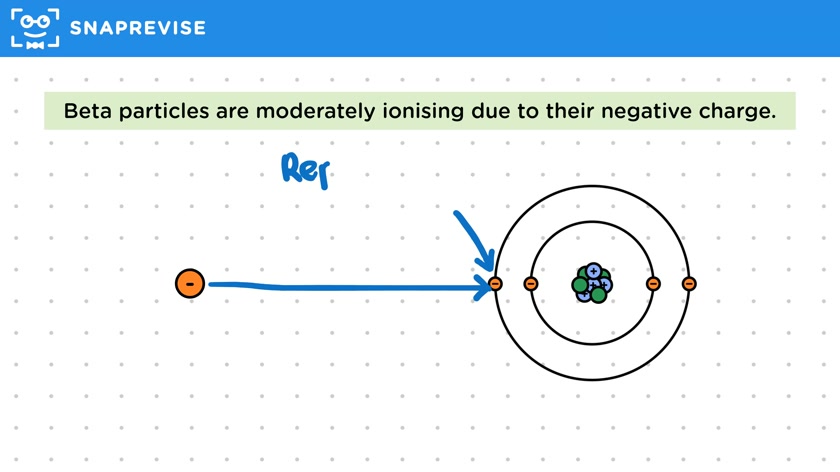
- Beta particles are moderately ionizing due to their negative charge.
- They can cause ionization through electrostatic repulsion, knocking electrons out of their orbit.
- Beta particles have less ionization compared to alpha particles.
- They can travel only a few meters in air.
- Beta particles lose energy due to ionization when colliding with air molecules.
- They can be stopped by a sheet of aluminum a few millimeters thick.
- Five millimeters of aluminum can stop beta particles as there are more atoms to interact with than in air.
Please subscribe to access these revision notes.
This, and all other video notes, are included in our premium subscriptions.
Premium accounts get access to all videos and revision notes.
137
questions for Atomic structure
71
questions for Atoms and nuclear radiation