
GCSE Physics (AQA)
346 videos | 23 hours
Please subscribe to watch this video.
This, and all other videos, are included in our premium subscriptions.
Premium accounts get access to all videos.
Enable autoplay to keep watching
Your browser is blocking videos from playing automatically. To turn it back on:
Safari (Mac): Click the Safari menu item in the top bar, then Settings → Websites → Auto-Play, then set Auto-Play to Allow All Auto-Play for the current website.
Safari (iPhone/iPad): open the Settings app, then Apps → Safari → Auto-Play, and select Allow All Auto-Play.
Calculating Efficiency
- Efficiency of energy transfer is calculated by dividing total useful output energy by total input energy.
- Efficiency represents the proportion of input energy that becomes useful output energy.
- Sankey diagrams help visualize energy distribution, showing total input energy, useful output energy, and wasted energy.
- Both total useful output energy and total input energy are measured in joules, resulting in efficiency having no units.
- Efficiency can be expressed as a percentage by multiplying by 100.
- Example: An oven uses 80 kilojoules of electrical energy to provide 30 kilojoules of thermal energy, resulting in an efficiency of 37.5%.
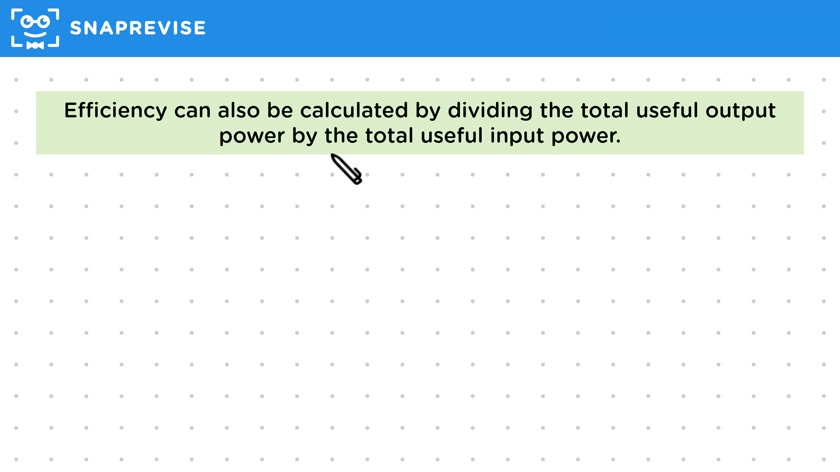
- Efficiency can also be calculated using power by dividing total useful output power by total input power.
- In continuous processes, the rate of useful and wasted energy output remains constant, allowing efficiency to be described in terms of power.
- Both useful output and total input power are measured in watts, with efficiency having no units but can be expressed as a percentage.
- Example: A low energy light bulb with 65% efficiency and 12 watts input power has a light energy output power of 7.8 watts.
Please subscribe to access these revision notes.
This, and all other video notes, are included in our premium subscriptions.
Premium accounts get access to all videos and revision notes.
88
questions for Energy
25
questions for Conservation and dissipation of energy