
GCSE Physics (AQA)
346 videos | 23 hours
Please subscribe to watch this video.
This, and all other videos, are included in our premium subscriptions.
Premium accounts get access to all videos.
Enable autoplay to keep watching
Your browser is blocking videos from playing automatically. To turn it back on:
Safari (Mac): Click the Safari menu item in the top bar, then Settings → Websites → Auto-Play, then set Auto-Play to Allow All Auto-Play for the current website.
Safari (iPhone/iPad): open the Settings app, then Apps → Safari → Auto-Play, and select Allow All Auto-Play.
Calculating Gas Volume & Pressure
- Gas pressure is inversely proportional to its volume at constant temperature.
- Pressure (P) is proportional to 1/Volume (V), expressed as P ��� 1/V.
- If pressure doubles, volume halves.
- Pressure multiplied by volume is constant: P * V = constant.
- Equation for systems at constant temperature: P1 * V1 = P2 * V2.
- Units for pressure can be Pascals, and volume can be meters cubed.
- Consistent units must be used before and after calculations.
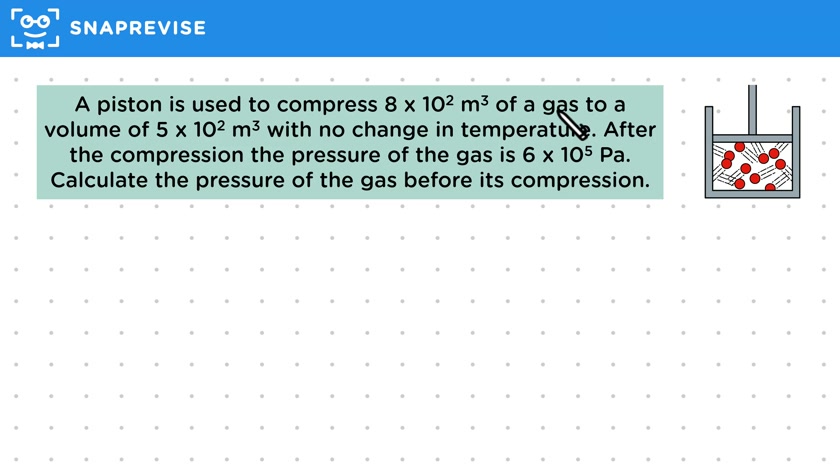
- Example problem: Calculate initial pressure before compression.
- Given: V1 = 8 x 10^2 m��, V2 = 5 x 10^2 m��, P2 = 6 x 10^5 Pa.
- Rearrange equation to solve for P1: P1 = (P2 * V2) / V1.
- Substitute values: P1 = (6 x 10^5 Pa * 5 x 10^2 m��) / 8 x 10^2 m��.
- Result: Initial pressure P1 = 3.75 x 10^6 Pa.
Please subscribe to access these revision notes.
This, and all other video notes, are included in our premium subscriptions.
Premium accounts get access to all videos and revision notes.
99
questions for Particle model of matter
21
questions for Particle model and pressure