
GCSE Physics (AQA)
346 videos | 23 hours
Please subscribe to watch this video.
This, and all other videos, are included in our premium subscriptions.
Premium accounts get access to all videos.
Enable autoplay to keep watching
Your browser is blocking videos from playing automatically. To turn it back on:
Safari (Mac): Click the Safari menu item in the top bar, then Settings → Websites → Auto-Play, then set Auto-Play to Allow All Auto-Play for the current website.
Safari (iPhone/iPad): open the Settings app, then Apps → Safari → Auto-Play, and select Allow All Auto-Play.
Calculating Work Done
- Work is the transfer of energy caused by a force moving an object a distance.
- Example: Pushing a box with a force causes it to move, indicating work is done and energy is transferred.
- Energy transfer involves converting chemical energy from the hand to kinetic energy in the box.
- The amount of energy transferred depends on the force applied and the distance moved.
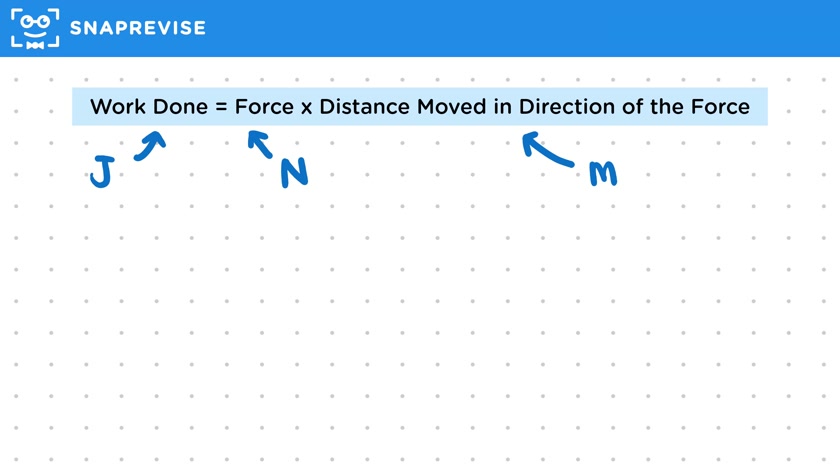
- Work done is calculated using the equation: Work = Force x Distance (in the direction of the force).
- Work done equals the amount of energy transferred.
- Distances are measured in the same or opposite direction to the force.
- Equation in symbol form: W = F x S, where W is work done, F is force, and S is distance.
- In exams, work describes various energy transfers, but calculations are for simple cases of measurable distance movement.
- Units: Force in Newtons, Distance in meters, Work in Joules.
- One Joule (J) is the work done when a one Newton force moves an object by one meter.
- Example: Applying a one Newton force to move a box one meter results in one Joule of work.
- Work measures the amount of energy transferred, not a type of energy itself.
- Example calculation: A 5 Newton force pushing a box 12 meters results in 60 Joules of work.
- Calculation steps: Write down key information, check units, use the formula (Work = Force x Distance), and calculate the result.
Please subscribe to access these revision notes.
This, and all other video notes, are included in our premium subscriptions.
Premium accounts get access to all videos and revision notes.
153
questions for Forces
3
questions for Work done and energy transfer