
GCSE Physics (AQA)
346 videos | 23 hours
Please subscribe to watch this video.
This, and all other videos, are included in our premium subscriptions.
Premium accounts get access to all videos.
Enable autoplay to keep watching
Your browser is blocking videos from playing automatically. To turn it back on:
Safari (Mac): Click the Safari menu item in the top bar, then Settings → Websites → Auto-Play, then set Auto-Play to Allow All Auto-Play for the current website.
Safari (iPhone/iPad): open the Settings app, then Apps → Safari → Auto-Play, and select Allow All Auto-Play.
Car Design
- Car engines convert chemical energy to kinetic energy.
- Chemical energy from fuel is converted to kinetic energy within the engine and wheels to move the car.
- The engine provides the driving force, doing work to move the car forward.
- The engine must work against resistive forces to keep the car in motion.
- Resistive forces include friction in moving parts, tire-road friction, and air resistance (drag).
- Kinetic energy is lost as work is done against friction and drag, converting it into heat.
- A driving force is needed to maintain speed and replace lost kinetic energy.
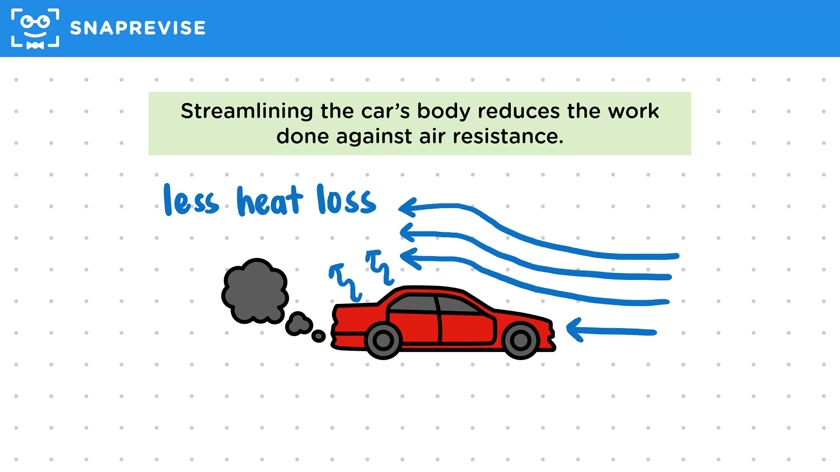
- Streamlining the car's body reduces work against air resistance by reducing collisions with air particles.
- Streamlining reduces energy loss to resistive forces and heat, requiring less energy to replace lost kinetic energy.
- Engines are designed to be energy efficient, converting most chemical energy to kinetic energy, with some loss to heat and sound.
- Moving parts are lubricated to reduce friction and heat loss, allowing smoother movement.
- Electric vehicles are more energy efficient with fewer moving parts.
- Car design is a common example of a system involving energy changes, dissipated energy, and steps to reduce energy loss through heat and friction.
Please subscribe to access these revision notes.
This, and all other video notes, are included in our premium subscriptions.
Premium accounts get access to all videos and revision notes.
88
questions for Energy
25
questions for Conservation and dissipation of energy