
GCSE Physics (AQA)
346 videos | 23 hours
Please subscribe to watch this video.
This, and all other videos, are included in our premium subscriptions.
Premium accounts get access to all videos.
Enable autoplay to keep watching
Your browser is blocking videos from playing automatically. To turn it back on:
Safari (Mac): Click the Safari menu item in the top bar, then Settings → Websites → Auto-Play, then set Auto-Play to Allow All Auto-Play for the current website.
Safari (iPhone/iPad): open the Settings app, then Apps → Safari → Auto-Play, and select Allow All Auto-Play.
Cells in Series
- A battery consists of multiple cells connected in series to achieve a higher potential difference than a single cell.
- The circuit symbol for a battery shows multiple cells connected in series, positive to negative, sometimes represented with a dotted line and a notch at the positive end.
- The total potential difference of a battery is the sum of the potential differences of the individual cells.
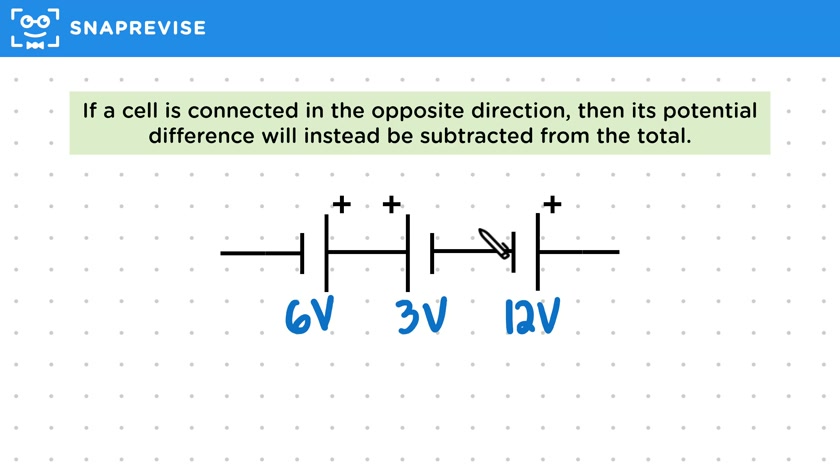
- If cells are connected with opposite polarity, their potential difference is subtracted from the total.
- Example: Cells of 6 volts, 3 volts (reversed), and 12 volts result in a total potential difference of 15 volts (6 - 3 + 12).
- In a circuit with four cells and a lamp, the potential difference and current direction are determined by the total potential differences in both clockwise and anti-clockwise directions.
- Example: Clockwise potential difference of 16 volts and anti-clockwise of 14 volts results in a net potential difference of 2 volts across the lamp, with current flowing in the clockwise direction.
Please subscribe to access these revision notes.
This, and all other video notes, are included in our premium subscriptions.
Premium accounts get access to all videos and revision notes.
144
questions for Electricity
29
questions for Series and parallel circuits