
GCSE Physics (AQA)
346 videos | 23 hours
Please subscribe to watch this video.
This, and all other videos, are included in our premium subscriptions.
Premium accounts get access to all videos.
Enable autoplay to keep watching
Your browser is blocking videos from playing automatically. To turn it back on:
Safari (Mac): Click the Safari menu item in the top bar, then Settings → Websites → Auto-Play, then set Auto-Play to Allow All Auto-Play for the current website.
Safari (iPhone/iPad): open the Settings app, then Apps → Safari → Auto-Play, and select Allow All Auto-Play.
Atomic structure
Nuclear fission and fusion (physics only)
Chain Reaction
3:13
Nuclear fission
Spec
4.4.4.1
- A nuclear fission reaction can cause further fission reactions, known as a chain reaction.
- Each fission reaction releases two to three neutrons.
- The larger nucleus splits into two smaller nuclei and neutrons during a fission reaction.
- Neutrons can be absorbed by a large nucleus to cause new fission reactions.
- Fission reactions start when a slow-moving nucleus is absorbed.
- The process continues until all fissile nuclei have split and released neutrons.
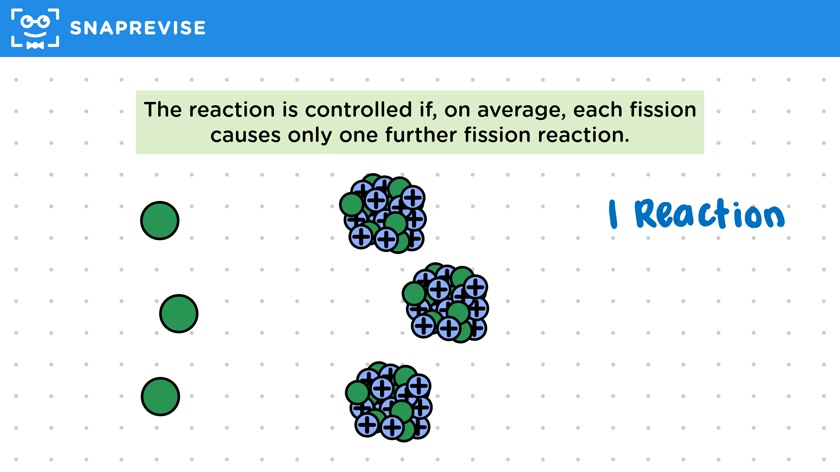
- A controlled chain reaction occurs if each fission causes only one further fission reaction.
- To control the reaction, two neutrons must be absorbed by non-fissile nuclei, allowing only one successive reaction.
- An uncontrolled reaction occurs if all released neutrons cause further fission reactions.
- Uncontrolled reactions lead to rapid increases in the rate of chain reactions.
- Uncontrolled chain reactions release huge amounts of energy, causing nuclear explosions.
- Nuclear weapons work by facilitating uncontrolled nuclear reactions.
- A nuclear explosion originates from a single nuclear reaction and releases unstable byproducts, leading to irradiation and contamination.
Please subscribe to access these revision notes.
This, and all other video notes, are included in our premium subscriptions.
Premium accounts get access to all videos and revision notes.
Report an Issue
Spotted something wrong? Let us know and we'll take a look.