
GCSE Physics (AQA)
346 videos | 23 hours
Please subscribe to watch this video.
This, and all other videos, are included in our premium subscriptions.
Premium accounts get access to all videos.
Enable autoplay to keep watching
Your browser is blocking videos from playing automatically. To turn it back on:
Safari (Mac): Click the Safari menu item in the top bar, then Settings → Websites → Auto-Play, then set Auto-Play to Allow All Auto-Play for the current website.
Safari (iPhone/iPad): open the Settings app, then Apps → Safari → Auto-Play, and select Allow All Auto-Play.
Change of State as a Physical Change
- During changes of state, the number of particles of a substance does not change.
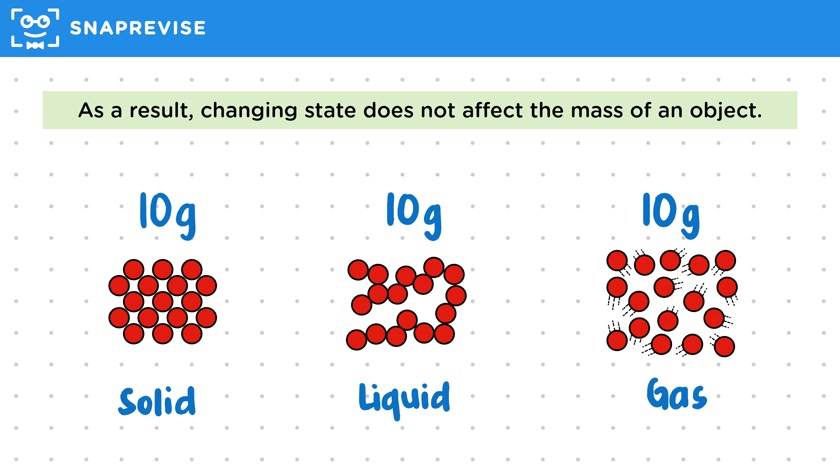
- In a solid, particles are arranged in a close regular structure.
- In a liquid, particles are in contact but can move past each other.
- In a gas, particles move randomly and are spread out.
- During changes of state, bonds become weaker, allowing particles to move and spread out more freely.
- Only the bonds change during changes of state; particles themselves remain unchanged, and no particles are created or destroyed.
- Changing state does not affect the mass of an object; the masses of each state are the same as the same particles are involved, just arranged differently.
- Although mass remains the same, density changes as particles are more spread out.
- All changes of state are reversible.
- Ice, water, and vapor are the same substance in different states and can transition between these states (e.g., melting, freezing, boiling, condensing).
- Changing state is a physical change, which is reversible, unlike chemical changes or reactions.
- In exams, one should be able to explain why mass doesn't change during changes of state and how a change of state is a physical change.
Please subscribe to access these revision notes.
This, and all other video notes, are included in our premium subscriptions.
Premium accounts get access to all videos and revision notes.
99
questions for Particle model of matter
34
questions for Changes of state and the particle model