
GCSE Physics (AQA)
346 videos | 23 hours
Please subscribe to watch this video.
This, and all other videos, are included in our premium subscriptions.
Premium accounts get access to all videos.
Enable autoplay to keep watching
Your browser is blocking videos from playing automatically. To turn it back on:
Safari (Mac): Click the Safari menu item in the top bar, then Settings → Websites → Auto-Play, then set Auto-Play to Allow All Auto-Play for the current website.
Safari (iPhone/iPad): open the Settings app, then Apps → Safari → Auto-Play, and select Allow All Auto-Play.
Comparing Orbits
- The larger the radius of an orbit, the longer a planet or satellite will take to travel around it.
- Orbits are paths taken by satellites around a planet or by planets around the sun due to gravitational forces.
- Mercury travels quickly with a shorter path around the sun, completing its orbit in 88 days.
- Venus travels more slowly with a longer path, taking 225 days to complete its orbit.
- The further a planet is from the sun, the longer it takes to complete its orbit.
- Data on orbits can be used to make predictions, such as estimating Saturn's orbital time at 30 years.
- Astronomers have used orbital data to predict the behavior of undiscovered planets.
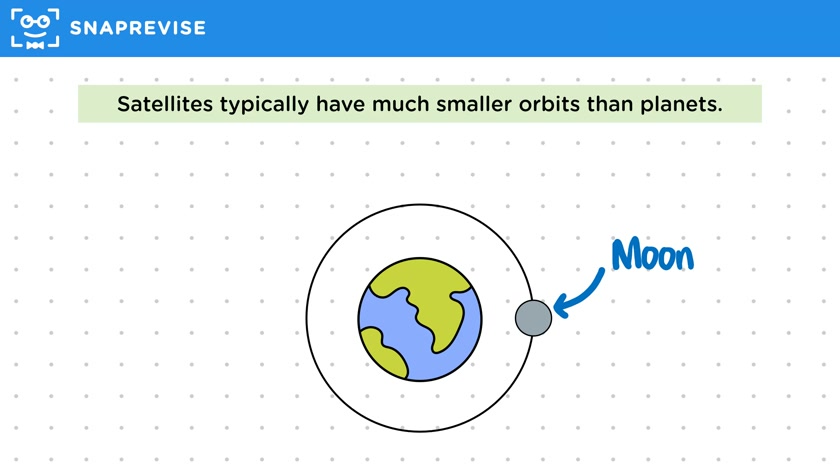
- Satellites typically have smaller orbits than planets, such as the moon orbiting Earth.
- The moon's orbit around Earth is 384,000 kilometers, over 100 times smaller than Mercury's orbit.
- Satellites complete orbits in less time due to shorter distances, e.g., the moon takes 27 days to orbit Earth.
- Understanding the relation between orbital radius and time is important for satellite positioning.
- Geostationary satellites are positioned to remain over the same point on Earth, requiring a 24-hour orbit.
- Geostationary satellites need an orbital radius of around 36,000 kilometers.
- Not all artificial satellites have the same radius; polar satellites have shorter orbits and are closer to Earth.
Please subscribe to access these revision notes.
This, and all other video notes, are included in our premium subscriptions.
Premium accounts get access to all videos and revision notes.
61
questions for Space physics (physics only)
42
questions for Solar system; stability of orbital motions; satellites (physics only)