
GCSE Physics (AQA)
346 videos | 23 hours
Please subscribe to watch this video.
This, and all other videos, are included in our premium subscriptions.
Premium accounts get access to all videos.
Enable autoplay to keep watching
Your browser is blocking videos from playing automatically. To turn it back on:
Safari (Mac): Click the Safari menu item in the top bar, then Settings → Websites → Auto-Play, then set Auto-Play to Allow All Auto-Play for the current website.
Safari (iPhone/iPad): open the Settings app, then Apps → Safari → Auto-Play, and select Allow All Auto-Play.
Conservation of Momentum
- In a closed system, the total momentum of colliding particles remains unchanged.
- Momentum is the product of mass and velocity.
- Example: Two billiard balls, where the first ball transfers its momentum to the second upon collision.
- Another example: Two people on roller skates, where momentum is shared between them after collision.
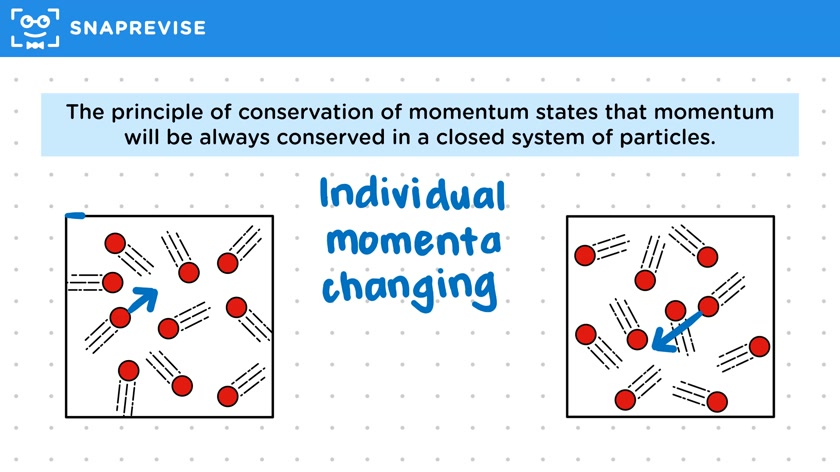
- The principle of conservation of momentum states that momentum is conserved in a closed system.
- Momentum cannot be gained or lost without transfer to another object.
- In a gas with many particles, individual momentum changes, but total momentum remains constant.
- Momentum is a vector, and total momentum is the vector sum of all particles' momentum.
- A closed system has no external forces acting on its particles.
- Example: Billiard balls in space with only reaction forces between them.
- An open system allows external forces, leading to changes in total momentum.
- Example: Billiard balls on a rough table experiencing friction, an external force.
- In exams, explain momentum conservation in closed systems or identify why a system isn't closed when momentum isn't conserved.
Please subscribe to access these revision notes.
This, and all other video notes, are included in our premium subscriptions.
Premium accounts get access to all videos and revision notes.
153
questions for Forces
32
questions for Momentum (HT only)