
GCSE Physics (AQA)
346 videos | 23 hours
Please subscribe to watch this video.
This, and all other videos, are included in our premium subscriptions.
Premium accounts get access to all videos.
Enable autoplay to keep watching
Your browser is blocking videos from playing automatically. To turn it back on:
Safari (Mac): Click the Safari menu item in the top bar, then Settings → Websites → Auto-Play, then set Auto-Play to Allow All Auto-Play for the current website.
Safari (iPhone/iPad): open the Settings app, then Apps → Safari → Auto-Play, and select Allow All Auto-Play.
Converging Ray Diagrams
- Convex lenses are used to form images on the opposite side of the lens.
- A convex lens is a glass device that causes light rays to refract and converge after passing through it.
- The principle axis is a straight line through the middle of the lens along which light rays won't refract.
- Images are formed by the refraction of light from an object through the lens.
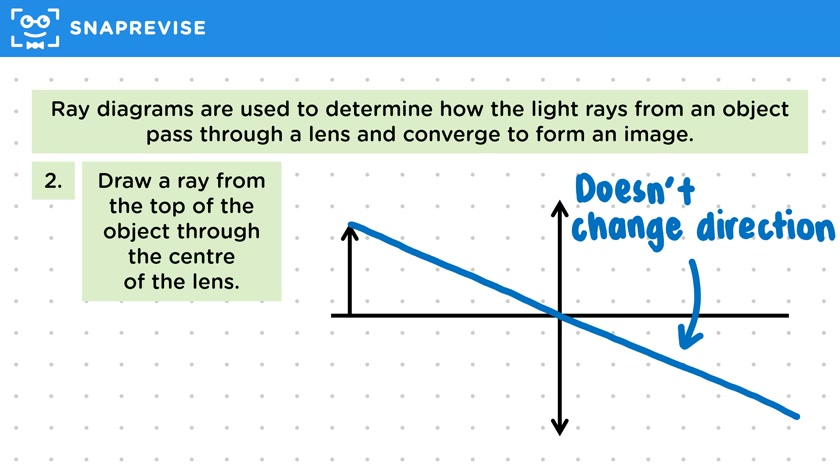
- Ray diagrams are used to determine how light rays from an object pass through a lens and converge to form an image.
- In exams, you may need to draw a ray diagram from scratch, usually given a lens and its principle axis.
- The convex lens symbol used in diagrams helps simplify drawing the rays.
- Steps to draw a ray diagram:
- 1. Draw an arrow from the principle axis to represent the object.
- 2. Draw a ray from the top of the object through the center of the lens; this ray will not change direction after passing through the lens.
- 3. Mark the principle focus of the lens where all rays parallel to the principle axis converge.
- 4. Draw a ray parallel to the principle axis to the lens, then through the focus.
- 5. Mark the other focus of the lens, which should be symmetrical to the first.
- 6. Draw a ray through this second focus and then parallel to the principle axis after passing through the lens.
- 7. Draw an arrow from the principle axis where the rays converge to represent the image.
- The image is represented as an arrow indicating its position and extent below the principle axis.
- Understanding this process is crucial for answering exam questions about lenses, which typically involve constructing or completing a ray diagram.
Please subscribe to access these revision notes.
This, and all other video notes, are included in our premium subscriptions.
Premium accounts get access to all videos and revision notes.
172
questions for Waves
81
questions for Electromagnetic waves