
GCSE Physics (AQA)
346 videos | 23 hours
Please subscribe to watch this video.
This, and all other videos, are included in our premium subscriptions.
Premium accounts get access to all videos.
Enable autoplay to keep watching
Your browser is blocking videos from playing automatically. To turn it back on:
Safari (Mac): Click the Safari menu item in the top bar, then Settings → Websites → Auto-Play, then set Auto-Play to Allow All Auto-Play for the current website.
Safari (iPhone/iPad): open the Settings app, then Apps → Safari → Auto-Play, and select Allow All Auto-Play.
Dark Matter & Dark Energy
- The Big Bang theory suggests the universe began as a small dense region and expanded outward.
- The explosion from the Big Bang gave all matter momentum, forming galaxies.
- The universe's expansion was expected to slow due to gravitational forces.
- Gravity, a non-contact force, pulls objects with large masses together.
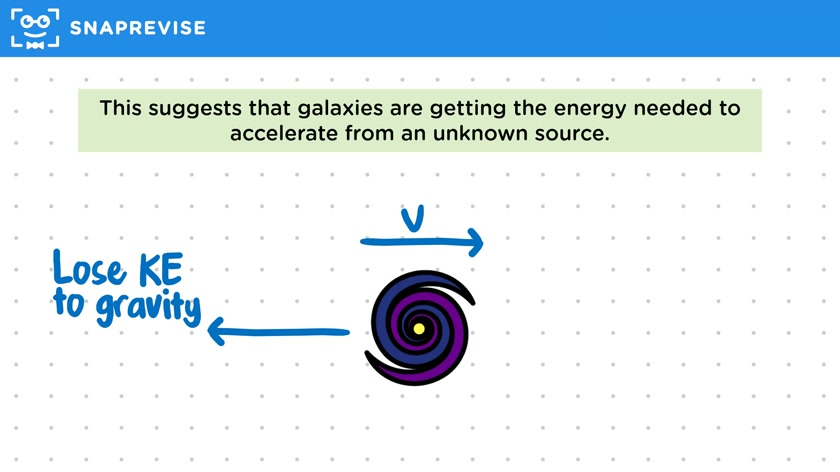
- Gravitational forces between galaxies should slow their speed, potentially leading to a "big crunch."
- Observations of distant supernovae suggest galaxies are accelerating, not slowing down.
- Galaxies are gaining energy from an unknown source, termed "dark energy."
- Dark energy is believed to be undetectable but observable through its effects.
- Galaxies rotate too quickly for their known masses, suggesting additional mass, termed "dark matter."
- Dark matter is theorized to exist based on its effects, though it is not directly observable.
- Dark matter and dark energy are believed to make up most of the universe.
- Normal matter constitutes only 5% of the universe, dark matter 27%, and dark energy 68%.
- There is much about the universe that remains unknown.
- GCSE exams require understanding the existence and implications of dark matter and dark energy.
Please subscribe to access these revision notes.
This, and all other video notes, are included in our premium subscriptions.
Premium accounts get access to all videos and revision notes.
61
questions for Space physics (physics only)
19
questions for Red-shift (physics only)