
GCSE Physics (AQA)
346 videos | 23 hours
Please subscribe to watch this video.
This, and all other videos, are included in our premium subscriptions.
Premium accounts get access to all videos.
Enable autoplay to keep watching
Your browser is blocking videos from playing automatically. To turn it back on:
Safari (Mac): Click the Safari menu item in the top bar, then Settings → Websites → Auto-Play, then set Auto-Play to Allow All Auto-Play for the current website.
Safari (iPhone/iPad): open the Settings app, then Apps → Safari → Auto-Play, and select Allow All Auto-Play.
Density
- Density of a material is defined as how much mass a certain volume of the material contains.
- Examples given include a feather (low density) and a rock (high density), compared to materials like wood, foam, and metals.
- Density is distinct from mass; one kilogram of feathers and one kilogram of rocks have the same mass but different densities.
- For exam purposes, exact densities are not required, but recognizing common examples of light and heavy objects is necessary.
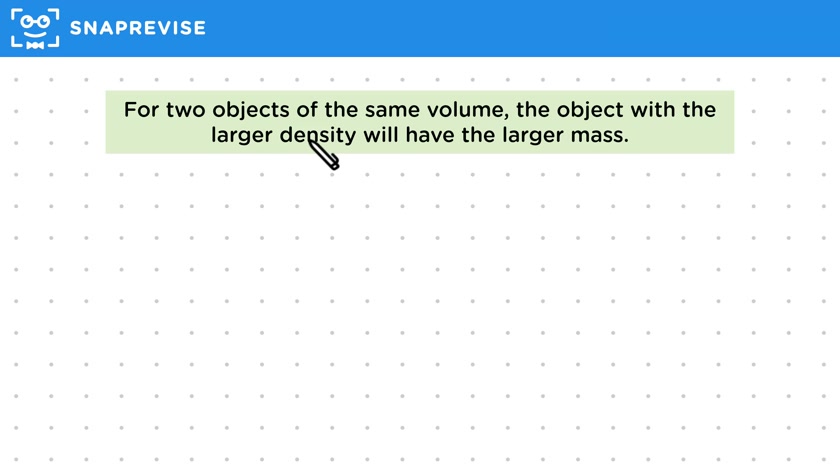
- Relationship between mass and density: for two objects of the same volume, the one with higher density will have greater mass.
- Example: a wooden ball and a metal ball of the same volume; the metal ball, having higher density, will also have a greater mass.
- To determine an object's density, measure its mass and volume.
- Mass can be measured using a pan balance.
- Volume can be measured by placing the object in water and observing the water displacement or calculating mathematically for regular shapes like spheres.
Please subscribe to access these revision notes.
This, and all other video notes, are included in our premium subscriptions.
Premium accounts get access to all videos and revision notes.
99
questions for Particle model of matter
34
questions for Changes of state and the particle model