
GCSE Physics (AQA)
346 videos | 23 hours
Please subscribe to watch this video.
This, and all other videos, are included in our premium subscriptions.
Premium accounts get access to all videos.
Enable autoplay to keep watching
Your browser is blocking videos from playing automatically. To turn it back on:
Safari (Mac): Click the Safari menu item in the top bar, then Settings → Websites → Auto-Play, then set Auto-Play to Allow All Auto-Play for the current website.
Safari (iPhone/iPad): open the Settings app, then Apps → Safari → Auto-Play, and select Allow All Auto-Play.
Density of States of Matter
- Changing the state of a substance affects its density.
- Density is calculated by dividing the mass of an object by its volume.
- Substances exist in three states of matter: solids, liquids, and gases.
- Solids have molecules arranged in a regular, rigid structure.
- Liquids have molecules in contact but free to move and flow around each other.
- Gases have molecules that spread out and move randomly.
- As a substance changes from solid to liquid to gas, its density decreases.
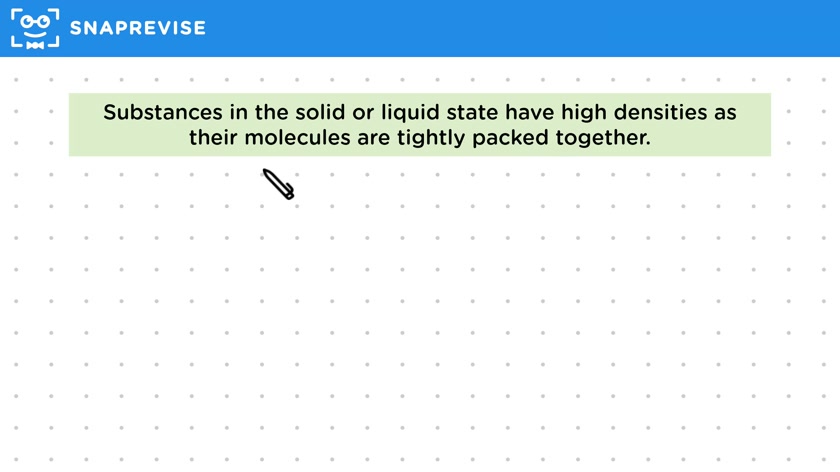
- Solids and liquids have high densities due to tightly packed molecules.
- In solids and liquids, there is little space between molecules, resulting in a large mass in a given volume.
- Solids and liquids have similar densities, but liquids are generally slightly less dense.
- An exception is ice, which is less dense than water.
- Gases have low densities because their molecules are spread out over a large volume.
- In gases, there is much more empty space between molecules, resulting in a small mass in a given volume.
Please subscribe to access these revision notes.
This, and all other video notes, are included in our premium subscriptions.
Premium accounts get access to all videos and revision notes.
99
questions for Particle model of matter
34
questions for Changes of state and the particle model