
GCSE Physics (AQA)
346 videos | 23 hours
Please subscribe to watch this video.
This, and all other videos, are included in our premium subscriptions.
Premium accounts get access to all videos.
Enable autoplay to keep watching
Your browser is blocking videos from playing automatically. To turn it back on:
Safari (Mac): Click the Safari menu item in the top bar, then Settings → Websites → Auto-Play, then set Auto-Play to Allow All Auto-Play for the current website.
Safari (iPhone/iPad): open the Settings app, then Apps → Safari → Auto-Play, and select Allow All Auto-Play.
Diffuse & Specular Reflection
- Diffuse reflection occurs when light reflects off a rough surface in multiple directions.
- Reflection is when a wave reaches a boundary and is sent back rather than crossing it or being absorbed.
- Diffuse reflection typically refers to visible light waves.
- A diffuse surface is bumpy and uneven, causing parallel rays to reflect in different directions.
- According to the law of reflection, the angle of incidence equals the angle of reflection, but uneven surfaces cause different normals at each point, leading to unpredictable reflections.
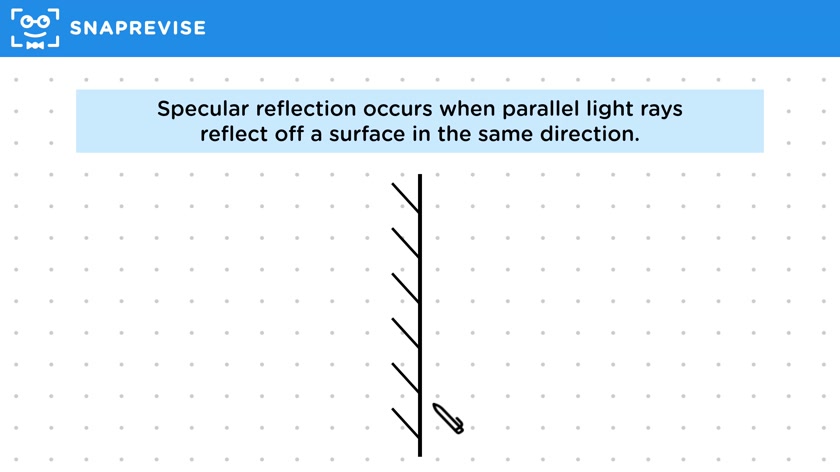
- Specular reflection occurs when parallel light rays reflect off a surface in the same direction.
- Specular surfaces, like mirrors and polished metals, are perfectly flat, allowing parallel rays to stay parallel after reflection.
- On a specular surface, a mirror image can be seen because reflected rays appear to originate from a point beyond the mirror.
- On a diffuse surface, like a brick wall, only the surface itself is visible due to light reflecting in all directions.
- Diffuse surfaces have bumps and imperfections, preventing image formation from reflected rays.
- For exams, understand the differences between diffuse and specular reflection and identify which is demonstrated in examples.
Please subscribe to access these revision notes.
This, and all other video notes, are included in our premium subscriptions.
Premium accounts get access to all videos and revision notes.
172
questions for Waves
81
questions for Electromagnetic waves