
GCSE Physics (AQA)
346 videos | 23 hours
Please subscribe to watch this video.
This, and all other videos, are included in our premium subscriptions.
Premium accounts get access to all videos.
Enable autoplay to keep watching
Your browser is blocking videos from playing automatically. To turn it back on:
Safari (Mac): Click the Safari menu item in the top bar, then Settings → Websites → Auto-Play, then set Auto-Play to Allow All Auto-Play for the current website.
Safari (iPhone/iPad): open the Settings app, then Apps → Safari → Auto-Play, and select Allow All Auto-Play.
Diverging Ray Diagrams
- Concave lenses form images on the same side of the lens.
- Lenses use specially shaped glass to refract light and form images.
- Concave lenses cause parallel light rays to refract and diverge, appearing to converge at a point before the lens.
- The principle axis is a straight line through the middle of the lens; rays traveling along it do not refract.
- An object on one side of the lens will have its image formed on the same side due to light refraction.
- The image formed is a virtual image, appearing to originate from a different point than the object.
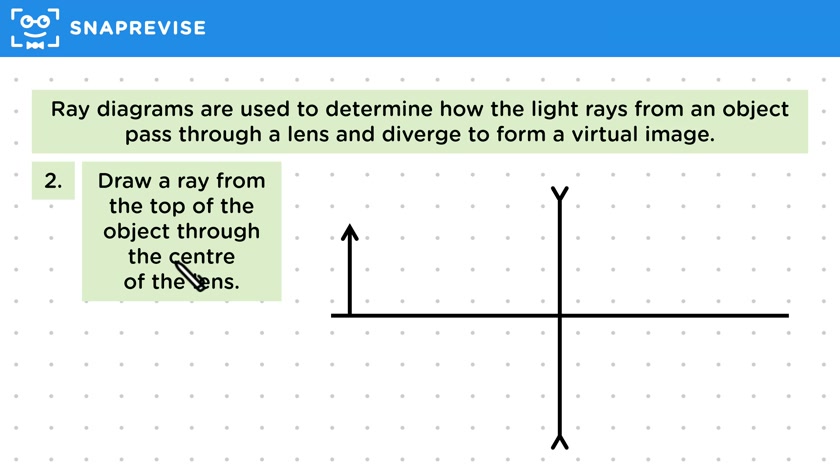
- Ray diagrams help determine how light rays pass through a lens and form a virtual image.
- In exams, the lens and principle axis may already be drawn; recognize the concave lens symbol.
- Concave lenses curve inwards at the top and bottom.
- Steps to draw a ray diagram for a concave lens:
- 1. Draw an arrow from the principle axis to represent the object.
- 2. Draw a ray from the top of the object through the center of the lens.
- 3. Mark the virtual focus of the lens.
- 4. Draw a ray parallel to the principle axis to the lens.
- 5. Draw the refracted ray so it passes through the focus when extended.
- 6. Draw an arrow from the principle axis to where the rays converge to represent the image.
- Understanding this process is crucial for exams, as you may need to draw diagrams for concave or convex lenses.
- Be aware of the differences between concave and convex lenses to avoid confusion.
Please subscribe to access these revision notes.
This, and all other video notes, are included in our premium subscriptions.
Premium accounts get access to all videos and revision notes.
172
questions for Waves
81
questions for Electromagnetic waves